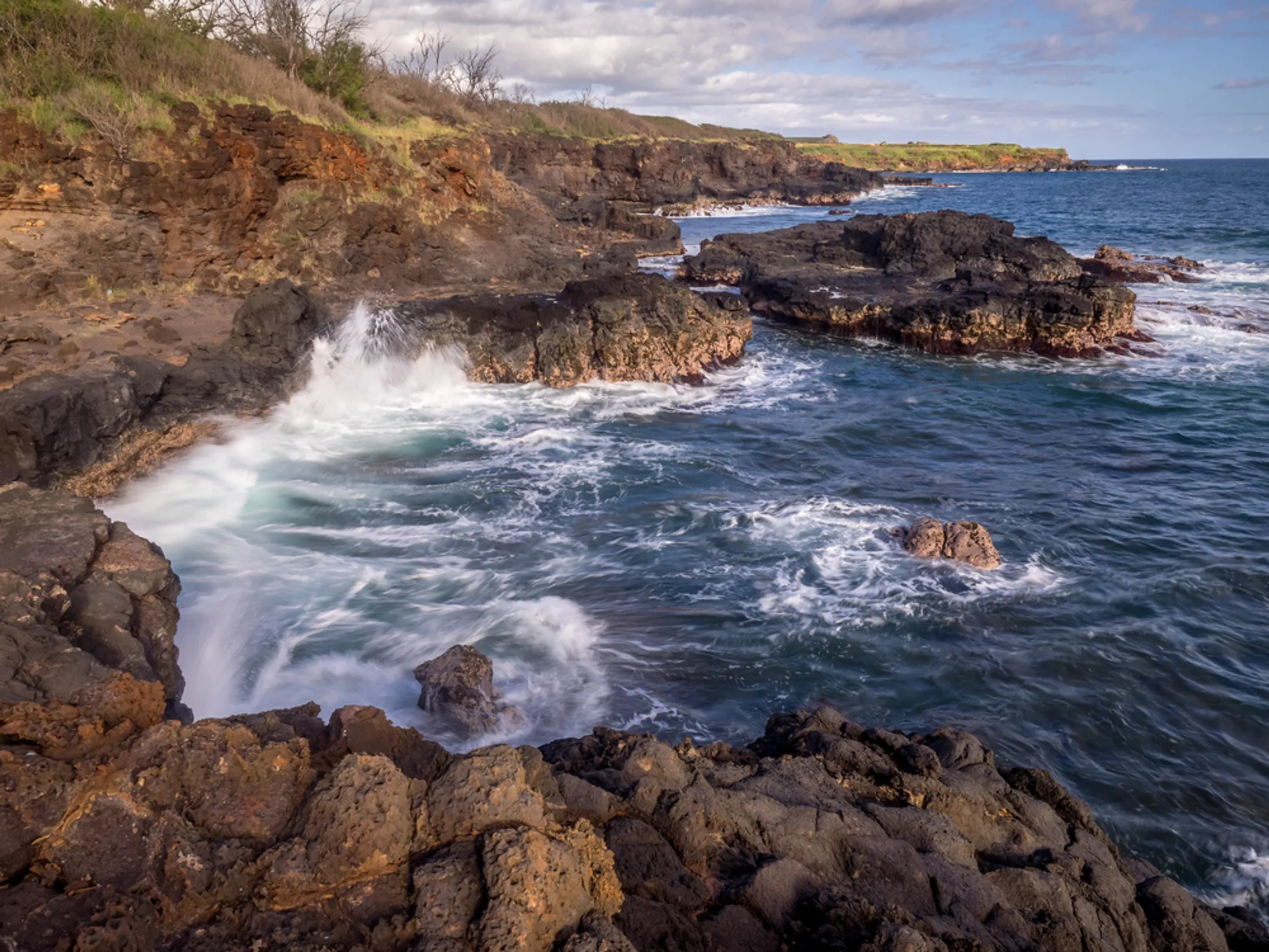
The Legend of Puʻu Pehe
Love, loss, and a lingering mystery at Sweetheart Rock

Written by a Local Cultural Guide
Kalani MillerThe Tale of the Sweethearts: The Moʻolelo of Makakehau and Pehe
The story begins with Makakehau, a powerful warrior whose name means "Misty Eyes." People called him this because whenever he gazed upon his beloved Pehe, his eyes would mist over with such profound love that tears would form. Pehe was a beautiful maiden from Lahaina, Maui, and her beauty was said to shine "like the clear sun rising out of Haleakala."
Makakehau's love for Pehe was so intense it bordered on obsession. Fearing he would lose her to other suitors who coveted her beauty, he brought her across the channel to Lānaʻi. There, he hid her in a sea cave at the base of the cliffs known as Malauea Cave, keeping her safe from rivals but also keeping her captive.
"Every day, Makakehau would leave Pehe in the cave while he traveled inland to gather fresh water from the mountain springs and collect food. She would wait for him in the dark chamber, watching the ocean through the cave's opening, perhaps dreaming of her home in Lahaina."
The Tragedy Unfolds
One day, while Makakehau was away on his daily journey, the weather changed suddenly. A fierce kona storm swept in from the south, bringing with it massive waves and violent winds. The storm surge rushed into Malauea Cave with tremendous force, and Pehe, trapped inside, tragically drowned.
When Makakehau returned to find his beloved gone, his grief was beyond measure. He cried out to the akua (gods), and they heard his anguish. The gods granted him supernatural strength, and he was able to scale the treacherous 80-foot sea stack that rises from the churning waters. Carefully, reverently, he carried Pehe's lifeless body to the summit of the rock.
There, high above the waves that had claimed her life, Makakehau built a tomb for his beloved. He laid her to rest with all the tenderness their love deserved. Then, unable to live without her, the grief-stricken warrior leaped from the precipice into the crashing waves below, choosing to join her in death.
The gods, moved by this ultimate act of devotion, allowed their spirits to remain together for eternity, bound to the sea stack that became their final resting place.
📚 Legend Details
- Warrior: Makakehau
- Maiden: Pehe
- Origin: Lahaina, Maui
- First Written: 1867
📖 Page Sections
👥 Key Characters
"Misty Eyes" - Lānaʻi warrior
Beautiful maiden from Maui
A Deeper Reading: Unpacking the "Sweetheart" Narrative
This romantic tale has captured hearts for generations, but the full story is more complicated than most people know. Some historical traditions suggest that Pehe wasn't a willing partner in this love story. She was described as being won as a "joint prize of love and war," which paints a very different picture from the mutual romance we often hear about.
The term "Sweetheart Rock" itself is largely a modern creation, shaped for visitor consumption. While the emotional power of the legend remains strong, this tourist-friendly framing can obscure the more complex realities of the original Hawaiian oral tradition.
The first formal written account of this legend appeared in 1867, penned by politician Walter Murray Gibson. His version was full of Victorian-era romanticism and extravagant details that likely contributed to the embellished story we know today. Gibson's flowery prose transformed what may have been a more nuanced indigenous story into something that fit the romantic sensibilities of his time.
The Lānaʻi Culture & Heritage Center offers important perspective on this evolution. They remind us that "Native traditions are rooted in real experience," acknowledging that while the story holds cultural truth, its contemporary framing as a simple romance may not capture the full complexity of the original moʻolelo.
This doesn't diminish the power of the legend. Instead, it invites us to approach it with deeper understanding and respect for the layers of meaning that oral traditions can hold.
The View from the Summit: Archaeological Fact vs. Enduring Legend
In 1921 and 1922, noted archaeologist Kenneth Emory led an expedition to solve the mystery of Puʻu Pehe once and for all. Scaling the dangerous sea stack, he carefully examined the stone structure on its summit that legend claimed was Pehe's tomb.
What Emory discovered changed everything we thought we knew about the site. Inside the structure, he found no human remains. Instead, there were only the bones of sea birds. This evidence led Emory to conclude that the structure wasn't a tomb at all, but likely an altar or shrine (heiau) built by ancient bird hunters or fishermen.
This scientific finding makes perfect sense when you consider that Puʻu Pehe is now designated as a State Seabird Sanctuary. The rock has always been a crucial nesting site for native Hawaiian seabirds, and ancient Hawaiians would have recognized its importance to these sacred creatures.
The Romantic Legend
The moʻolelo speaks to universal human experiences of love, loss, and devotion. It teaches about the dangers of possessive love and the consequences of our actions.
This story continues to resonate because it touches something deep in the human heart, regardless of its historical accuracy.
The Archaeological Truth
Kenneth Emory's findings reveal ancient Hawaiian spiritual practices and their deep connection to the natural world, particularly seabirds.
The structure was likely a koʻa (fishing shrine) or altar used by bird hunters, showing practical spirituality.
But here's what makes this place so fascinating: even though the "tomb" theory has been scientifically debunked, the moʻolelo remains the primary way people understand and connect with this landmark. The legend and the archaeological facts can coexist, each offering different kinds of truth about this remarkable place.
The story continues to resonate because it speaks to universal human experiences of love, loss, and devotion. The scientific evidence tells us about ancient Hawaiian spiritual practices and their deep connection to the natural world. Together, they create a richer, more complete picture of what Puʻu Pehe truly means.