
The Heart of Lahaina
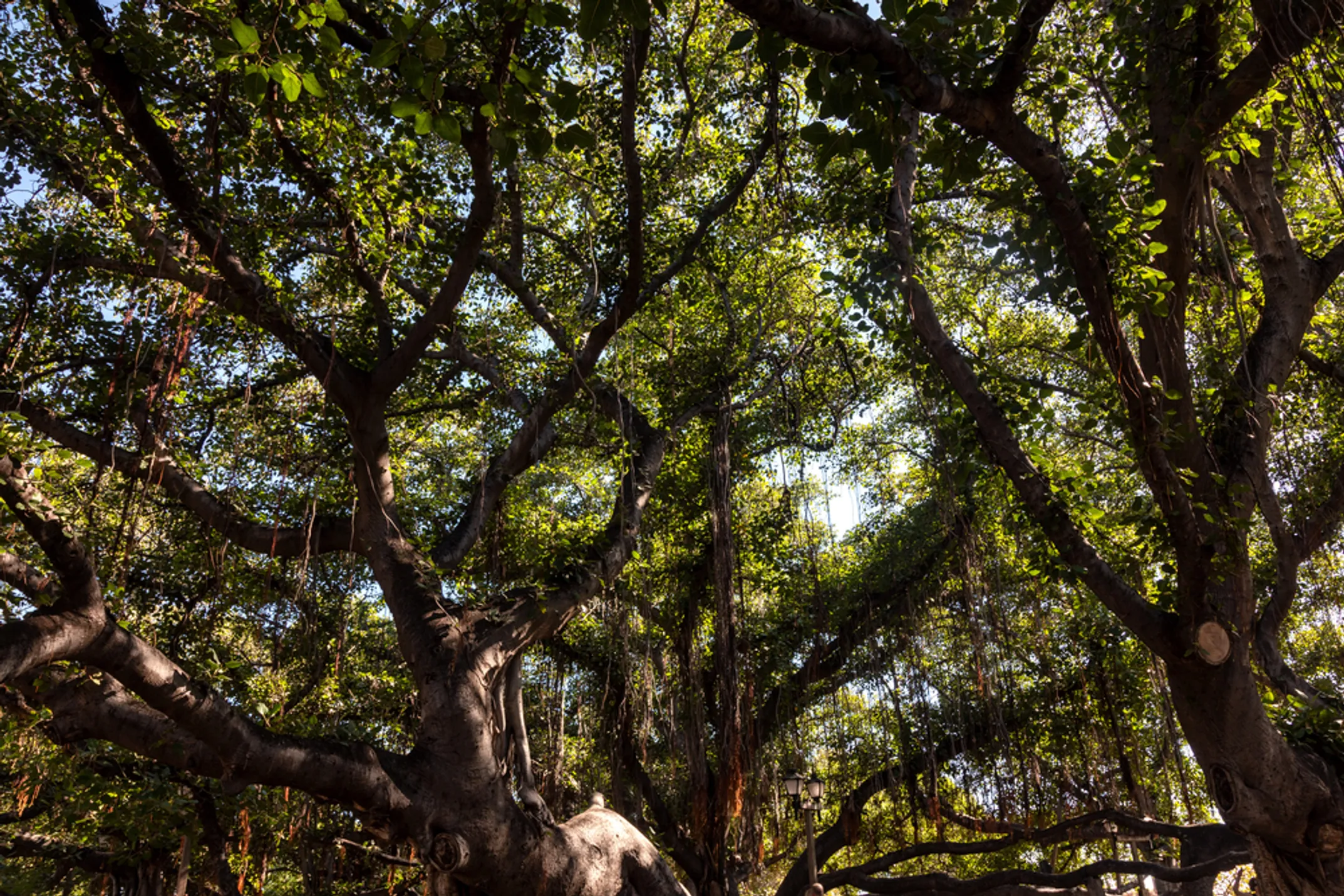
Aloha mai kākou. For those of us who grew up on Maui, the Lahaina Banyan Tree wasn't just a landmark on Front Street. It was the island's living room, its shady heart. I remember countless afternoons spent under its sprawling canopy, escaping the heat. The name Lahaina comes from Lele, which means relentless sun. My cousins and I would chase the mynah birds that chattered in its branches and trace the patterns of light filtering through the leaves, feeling safe within the embrace of its massive trunks.
It was the backdrop for everything. The vibrant Art in the Park fairs happened here twice a month. During the holidays, thousands of lights turned the tree into something magical. There were quiet moments too, just being a kid on Maui. It was more than a tree. It was a constant, a silent guardian that connected generations of our ʻohana and community.
This tree has been a central character in Lahaina's story for over 150 years. It has watched kingdoms fall and industries rise. A town evolved around its ever-expanding roots. Then, in August 2023, it faced its greatest trial.
An inferno stole so much from so many. In the aftermath, as our community grappled with unimaginable loss, all eyes turned to the fate of our tree. This article tells the full story of the Lahaina Banyan Tree. It is a story of a complex past, a miraculous survival, and a powerful new beginning. The tree has become the ultimate symbol of hope and resilience. It represents the unbreakable spirit of Lahaina.
Join me as we explore its deep roots in our history, witness its incredible journey of recovery, and learn what it means to visit this sacred place today with the respect and aloha it deserves.
A Witness to History: The Roots of the Lahaina Banyan Tree
The story of the Lahaina Banyan Tree is woven deeply into the fabric of Hawaiian history. Its planting was not just a botanical event but a cultural marker. It represented a period of immense change for Lahaina and the entire kingdom. To understand the tree is to understand the forces that shaped modern Maui.
The Planting of a Landmark
On April 24, 1873, a young Indian banyan sapling was planted in the center of Lahaina's Courthouse Square. The species, known scientifically as Ficus benghalensis, is called paniana in Hawaiian. Standing a mere eight feet tall, it was a gift sent from missionaries in India. The sapling commemorated the 50th anniversary of the first American Protestant mission on Maui. The duty of planting the sapling fell to William Owen Smith, who was the Sheriff of Lahaina at the time.
This historical moment is layered with significance. The Protestant mission, whose anniversary was being celebrated, had originally been invited to the islands by Queen Keōpūolani. She was the sacred wife of King Kamehameha the Great and a powerful figure in her own right. Her invitation and subsequent conversion to Christianity in 1823 marked a profound shift in the cultural and political landscape of Hawaiʻi. It set the stage for decades of Western influence that would forever alter the kingdom's trajectory. The planting of the banyan tree stands as a living monument to this transformative period.
🌳 Size & Age
Over 150 years old, standing 60+ feet tall with a canopy covering nearly two-thirds of an acre—the largest banyan tree in the United States.
🏛️ Historic Significance
Planted in 1873 to commemorate the 50th anniversary of the first Protestant mission on Maui—a living witness to Hawaiian history.
🌱 Community Creation
16 major trunks formed from aerial roots that were guided by generations of Lahaina residents using water-filled jars.
🔥 2023 Fire Survival
Survived the devastating August 2023 wildfire and is now thriving with new growth—a symbol of Lahaina Strong resilience.
Explore the Complete Story
Discover the full history, miraculous survival, and what it means to visit this sacred symbol of hope today.
ℹ️ Quick Info
- Location: Front Street
- Age: 150+ years
- Height: 60+ feet
- Canopy Size: 2/3 acre
- Current Status: Recovering
⚠️ Important Notice
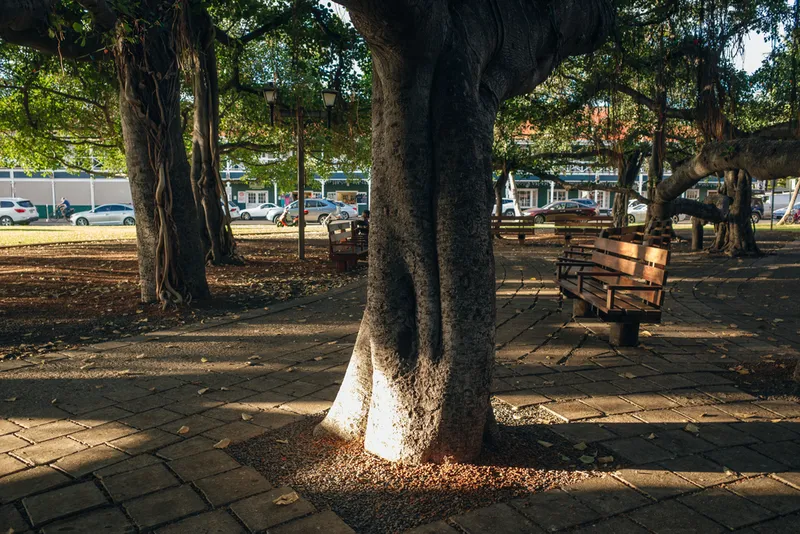
Banyan Court Park remains closed to the public as of late 2025. The tree can be viewed from a distance while respecting the recovery zone.
Please do not enter restricted areas or the burn zone.
📅 Key Dates
- April 24, 1873
Tree planted - August 8, 2023
Lahaina wildfire - September 2023
First new leaves
A Community's Creation: From Sapling to Forest
From that single, slender sapling grew a botanical marvel. The Lahaina Banyan is not just one tree but a forest unto itself. Over 150 years, it has grown to a height of over 60 feet. Its sprawling canopy covers nearly two thirds of an acre. That's the size of an entire city block. Its unique biology allows it to send down aerial roots from its branches. When these roots reach the soil, they thicken and form new trunks. Today, the tree is supported by 16 major trunks in addition to its original core. This creates a vast, interconnected labyrinth of wood and leaves. It is recognized as the largest banyan tree in both Hawaiʻi and the entire United States.
This incredible growth was not merely an act of nature. It was a project of the community. The people of Lahaina actively nurtured and shaped the tree. They guided its expansion with care and ingenuity. Members of the local Japanese gardening community, along with other residents, would hang glass jars or lanterns filled with water on promising aerial roots. The weight and the lure of water encouraged these roots to grow directly downward. This ensured they would successfully anchor into the earth and become the strong, supportive trunks that define the tree's immense structure today.
This decades-long relationship demonstrates a profound connection between the people and the tree. It transformed the tree from an imported specimen into a co-creation of the Lahaina community. The tree became something entirely new, shaped by the hands and hearts of generations who called this place home.
The Piko of Lahaina Life
For a century and a half, the Banyan Tree served as the piko of community life in Lahaina. In Hawaiian, piko means the center, the navel. It was the town's natural gathering place, a living landmark that anchored the social and cultural heartbeat of Front Street. Under its generous shade, generations of locals and visitors found respite from the heat of the day.
The space beneath its canopy was a stage for life's celebrations, big and small. It hosted countless community events that became cherished traditions. The twice-monthly Art in the Park brought local artists together to share their work. The annual Lighting of the Banyan Tree kicked off the holiday season with 6,500 sparkling lights. Halloween costume contests drew crowds from all over the island. It was also a venue for cultural gatherings, including Japanese Obon festivals honoring ancestors, lively block parties, and dance performances.
The tree's history as a celebratory space goes back to the days of the monarchy. It once hosted a birthday party for King Kamehameha III, the kingdom's longest-reigning monarch. Beyond these events, the tree stood as a silent witness to history. It watched as Lahaina, once the capital of the Hawaiian Kingdom, evolved through the whaling era and the sugar industry.
It was already standing in 1898 during the annexation of Hawaiʻi. That was a somber moment when the flag of the Hawaiian Kingdom was lowered and replaced by the American flag at the nearby courthouse. Each ring in its trunk holds the memory of Lahaina's complex and layered past.
A Complicated Legacy
While the Banyan Tree is overwhelmingly beloved, its origins are rooted in a history that is, for many, deeply painful. Its very existence commemorates the arrival of missionaries. While these missionaries were invited by aliʻi, they brought changes that led to the erosion of traditional Hawaiian systems and beliefs. This complexity is embodied by the man who planted it, William Owen Smith.
Smith was more than just the sheriff of Lahaina. He was the son of American missionaries and a lawyer who became a powerful political figure. He was a member of the Hawaiian League and one of the drafters of the 1887 "Bayonet Constitution." This document forced King Kalākaua to sign under duress. It stripped the monarchy of much of its authority and disenfranchised many Native Hawaiian voters.
Later, Smith played a key role in the "Committee of Safety." This was the group of American and European businessmen who organized the illegal overthrow of the Kingdom of Hawaiʻi. They deposed Queen Liliʻuokalani in 1893.
Because of this direct connection to the downfall of the Hawaiian nation, the Banyan Tree is viewed by some Native Hawaiians as a living symbol of colonialism. It serves as a reminder of the dispossession of their lands and the suppression of their culture. After the 2023 fire, this perspective came to the forefront. Some community members questioned the intense focus on saving a non-native tree. Sacred and life-sustaining native groves of ʻulu (breadfruit) had also been devastated in the fire.
Yet the tree's story did not end with its planting. For 150 years, the diverse community of Lahaina made the tree their own. Hawaiians, Japanese, Chinese, Portuguese, Filipinos, and others who came to call Maui home were the ones who nurtured its growth. They gathered under its branches for celebrations. They wove it into the fabric of their daily lives.
The massive effort to save the tree after the fire marked a profound turning point. The effort began with a blessing from a Hawaiian cultural practitioner. The tree is now being reborn, its identity reclaimed by the very community it has sheltered for so long. It stands today less as a symbol of its planter and more as a testament to the resilience and unity of the people of Lahaina. It represents the enduring aloha that binds this community together.