The Year the Sky Fell
Puna, 1790: When Volcanic Fury Changed Hawaiian History

Written by a Local Expert
Leilani AkoPart II: The Year the Sky Fell: Puna, 1790
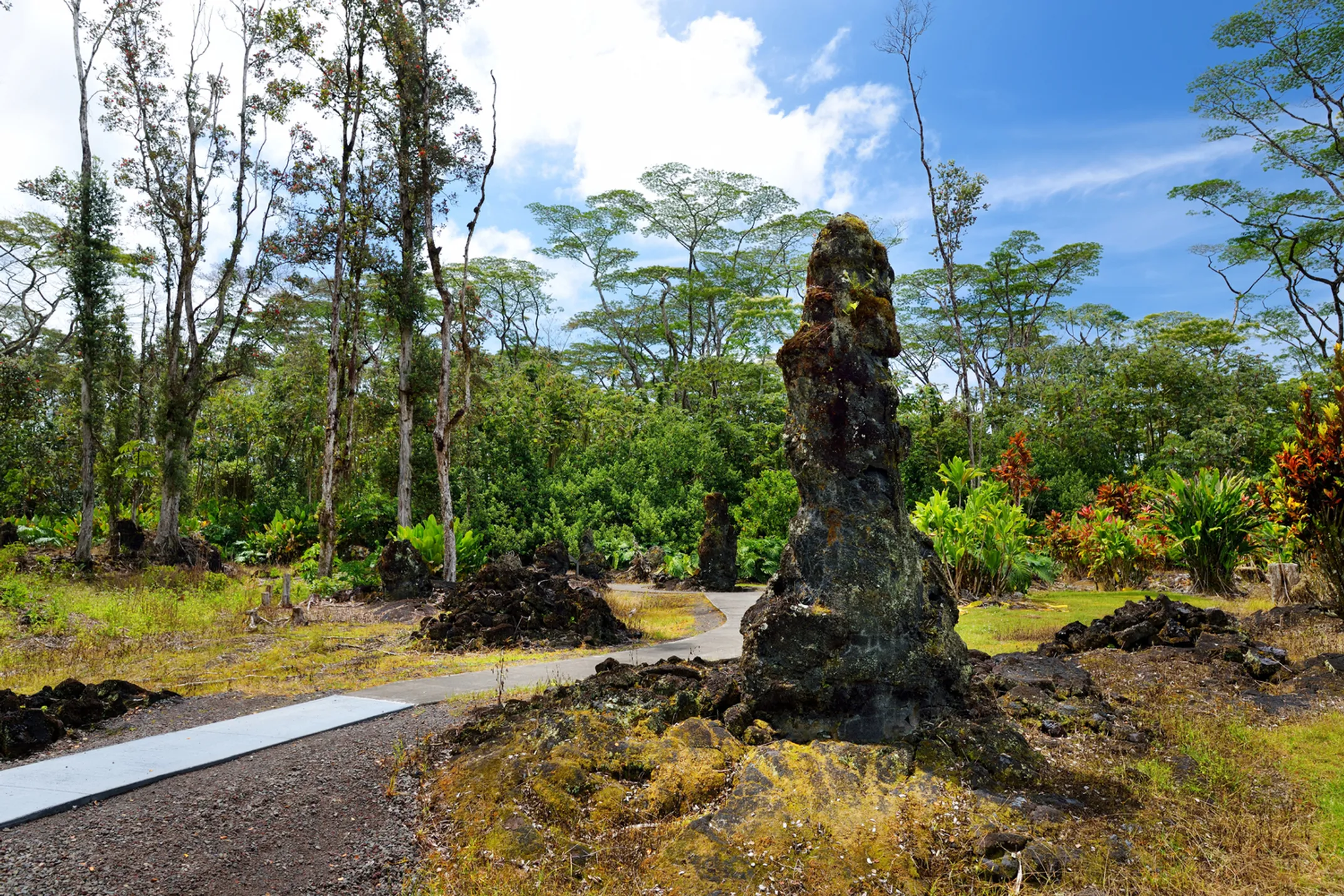
To truly understand the ghostly figures of Lava Tree State Monument, we must travel back in time, beyond the paved path and picnic tables, to the world they inhabited. The year is 1790. The Hawaiian Islands are on the cusp of monumental change, and the Puna district is a thriving, complex society living in the shadow of a restless goddess.
The eruption that created these lava trees was not just a geological event. It was a human tragedy and a historical turning point.
Life on the Edge: Puna Before the Cataclysm
In the late 18th century, the Puna and neighboring Kaʻū coastlines were home to a network of established communities. Archaeological surveys within what is now the Puna-Kāʻu Historic District reveal a society that had masterfully adapted to this rugged landscape over centuries. Life was anchored to the coast, with villages like Kamoamoa, Kailiili, and Laeʻapuki serving as hubs for a society deeply connected to the sea.
The people here were expert fishermen and practitioners of aquaculture, managing coastal resources with a sophistication born from generations of observation. Their world was not confined to the shoreline. A complex system of trails connected the coastal settlements to the upland agricultural fields, where they cultivated staple crops. These paths also led to prized resources in the volcanic highlands, such as volcanic glass for tools and wood for canoes.
This was also a land of deep spiritual significance. The most powerful testament to this is the Wahaʻula Heiau ("Red-mouth temple"), a massive temple structure, or luakini, located in the heart of this coastal region. Tradition holds that this temple was first established by the high priest Pāʻao, who arrived from Kahiki (Tahiti) around the 13th century and introduced a new, more rigid form of religious practice, which included human sacrifice.
The existence of such a major religious center indicates a highly organized, hierarchical society. Wahaʻula was the spiritual anchor for the entire region, a place of immense mana (divine power) that governed the lives of the people. This was the vibrant, sacred, and populated world that existed on the eve of the eruption—a world that was about to be irrevocably shattered.
The Keanakākoi Eruption: A Tragedy in Three Acts
In November 1790, Kīlauea awoke in a way no one alive had ever witnessed. The eruption, now known as the Keanakākoi eruption, was not the familiar, effusive flow of lava that Hawaiians were accustomed to. It was a series of violent, explosive blasts from the summit caldera, a type of eruption that occurs when magma interacts explosively with groundwater. The event unfolded in three distinct, terrifying phases.
Act I - The Warning
The eruption began not with fire, but with a cloud of darkness. A phreatomagmatic explosion sent a plume of wet, fine-grained ash into the air, carried southwest by trade winds across the Kaʻū Desert.
Act II - The Inferno
The second explosion was the most powerful, generating a colossal column of ash and rock 12-15 kilometers high, visible from Kawaihae 100 kilometers away.
Act III - The Killing Wind
The eruption column collapsed, creating a pyroclastic density current that swept across the landscape at hurricane speeds, killing Keōua's party instantly.
Act I - The Warning: The eruption began not with fire, but with a cloud of darkness. A phreatomagmatic explosion sent a plume of wet, fine-grained ash into the air, which the trade winds carried southwest across the Kaʻū Desert. It was into this muddy, still-unconsolidated ash that a group of people, mostly women and children, left an indelible record of their terror: hundreds of footprints, preserved for eternity. The footprints point in multiple directions, some away from the summit, some back toward it, painting a chaotic picture of flight and confusion. They are the most tangible and haunting connection we have to the human experience of this disaster.
Act II - The Inferno: The second explosion was the most powerful. It generated a colossal column of ash and rock that rocketed an estimated 12 to 15 kilometers (40,000 to 50,000 feet) into the atmosphere. The plume was so immense that it was seen by John Young, a marooned British sailor living in Kawaihae, nearly 100 kilometers away, who noted the terrifying sight in his ledger. This blast sent debris high into the jet stream, raining down sand and gravel-sized particles for miles around.
Act III - The Killing Wind: The eruption's final act was its most lethal. The towering eruption column, too heavy to support its own weight, collapsed back upon itself. This collapse generated a pyroclastic density current—a ground-hugging, turbulent surge of superheated gas, steam, and volcanic debris that raced across the landscape at hurricane speeds. This deadly surge swept across the western flank of the volcano, directly over a trail being used by a party of warriors and their families led by the chief Keōua. Death was instantaneous. Accounts gathered from survivors decades later by the missionary Sheldon Dibble paint a gruesome picture. The victims were not buried or battered, but found "sitting upright clasping with dying grasp their wives and children," their bodies "thoroughly scorched" by the intense heat. This party, estimated to number at least 80 and perhaps as many as 400 people, was annihilated in an instant, making it the deadliest volcanic eruption in the history of what is now the United States.
Forging a Monument in Fire
While this explosive tragedy was unfolding at Kīlauea's summit, a different kind of volcanic activity was taking place down on the East Rift Zone. An effusive lava flow, part of the same complex volcanic event, was making its way through the dense ʻōhiʻa rainforest of Puna. This was the flow that would create Lava Tree State Monument.
The science is a matter of perfect, violent timing. The pāhoehoe lava was fluid and moving fast. As it encountered the large, moisture-rich trunks of the ʻōhiʻa trees, the water in the wood flashed to steam. This steam created a temporary, insulating barrier between the tree and the molten rock. The lava chilled and hardened against this barrier, forming a perfect mold of the tree's exterior before the tree itself was consumed by the heat. When the main pulse of the lava flow subsided and drained away, these hollow stone casts were left standing, a silent, ghostly forest born from the same cataclysm that had claimed so many lives just miles away.
The 1790 eruption was more than a geological event or a human tragedy. It was a profound political catalyst. At the time, the Big Island was embroiled in a civil war between two powerful cousins: Keōua, who controlled Kaʻū and Puna, and Kamehameha, who controlled Kohala and Kona. The army destroyed by the pyroclastic surge was Keōua's. In the Hawaiian worldview, natural phenomena were potent expressions of divine will. This devastating and seemingly targeted event was widely interpreted as a sign that the volcano goddess, Pele, had sided with Kamehameha. Keōua's forces were demoralized, and his political and spiritual authority was shattered. The following year, Kamehameha would defeat Keōua and go on to unify the entire Hawaiian archipelago, establishing the Hawaiian Kingdom. The quiet, strange park in Puna is, therefore, not just a monument to a forest. It is an accidental monument to a pivotal moment in Hawaiian history, a place where the will of a volcano helped forge a nation.
📖 Story Chapters
Trail guide & formations
Current chapter
Modern witness
Part IV: The Enduring CyclePhilosophy & resilience
📅 1790 Timeline
- November 1790: Kīlauea erupts explosively
- Act I: Ash cloud covers Kaʻū Desert
- Act III: Pyroclastic surge kills Keōua's army
- Same time: Lava trees form in Puna
- 1791: Kamehameha unifies the islands
👑 Key Historical Figures
Chief Keōua
Kamehameha's rival, lost army in eruption
Kamehameha
Future king, benefited from eruption
John Young
British sailor who witnessed eruption
🌋 Eruption Facts
- Eruption column: 12-15 km high
- Visible from 100 km away
- 80-400+ people killed
- Deadliest US volcanic event
- Changed Hawaiian politics forever