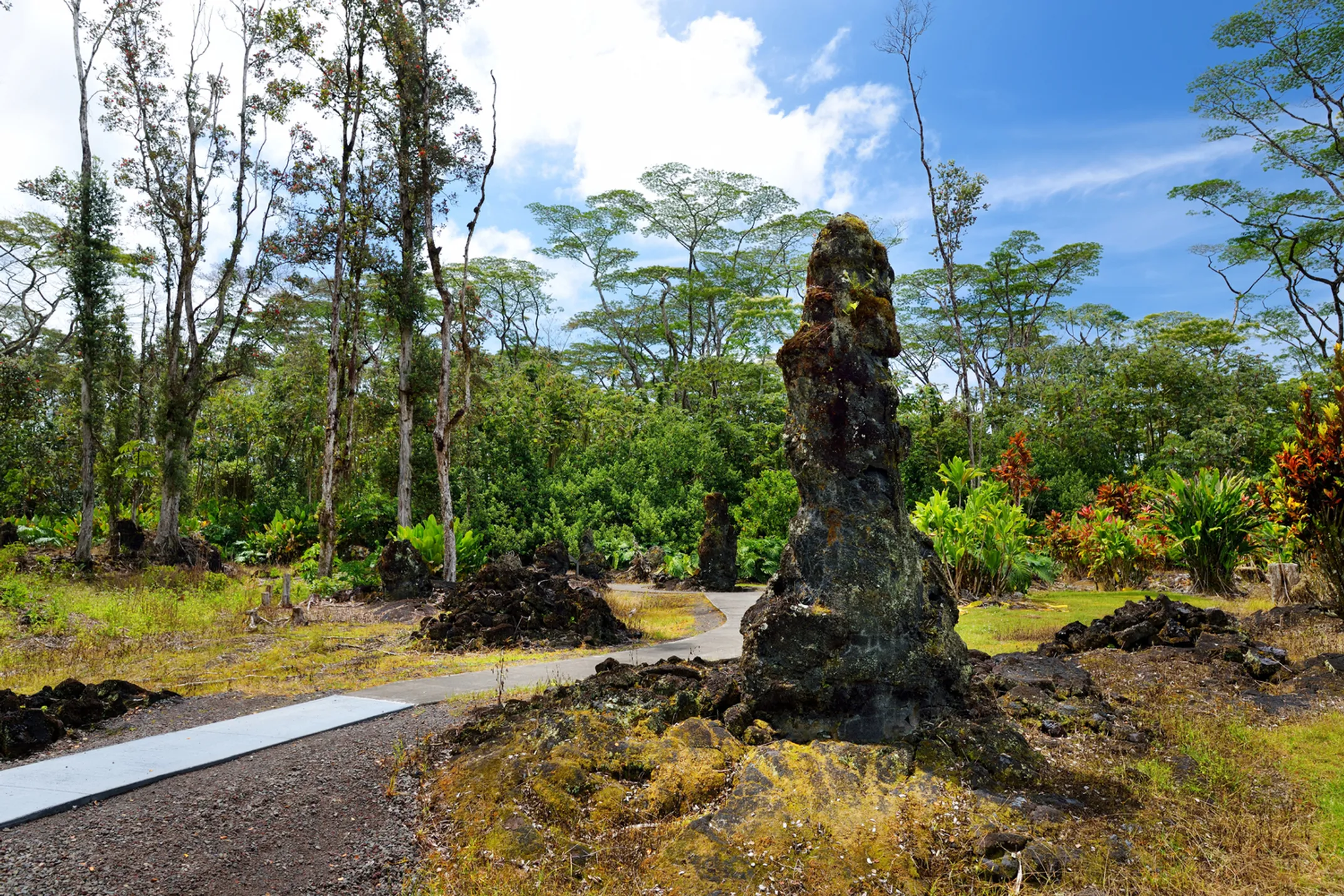
The Stone Forest: Lava Tree State Monument
A Journey Through Time at Hawaii's Most Haunting Natural Monument

Written by a Local Expert
Leilani AkoThe first thing you notice is the quiet. One moment you're on a narrow country road in Puna, the air buzzing with the familiar chorus of coqui frogs and the hum of a passing car. The next, you step out of the small parking lot and onto a paved path, and the world falls silent. It's a heavy, weighted silence, the kind that feels older than sound itself.
The air, thick with the scent of damp earth, wild ginger, and decay, seems to press in on you. And then you see them. All around you, rising from a chaotic floor of mossy rock and tangled ferns, are the trees. But they are not trees of wood. They are pillars of black, porous stone, silent and skeletal.
Some stand tall and defiant, their forms still perfectly mimicking the trunks of the great ʻōhiʻa trees they once were. Others are broken and hollow, their jagged shells now cradling new life—ferns, mosses, even small saplings sprouting from their tops. This is Lava Tree State Monument, a forest of ghosts, a sculpture garden carved by a goddess in a single, fiery afternoon over two centuries ago.
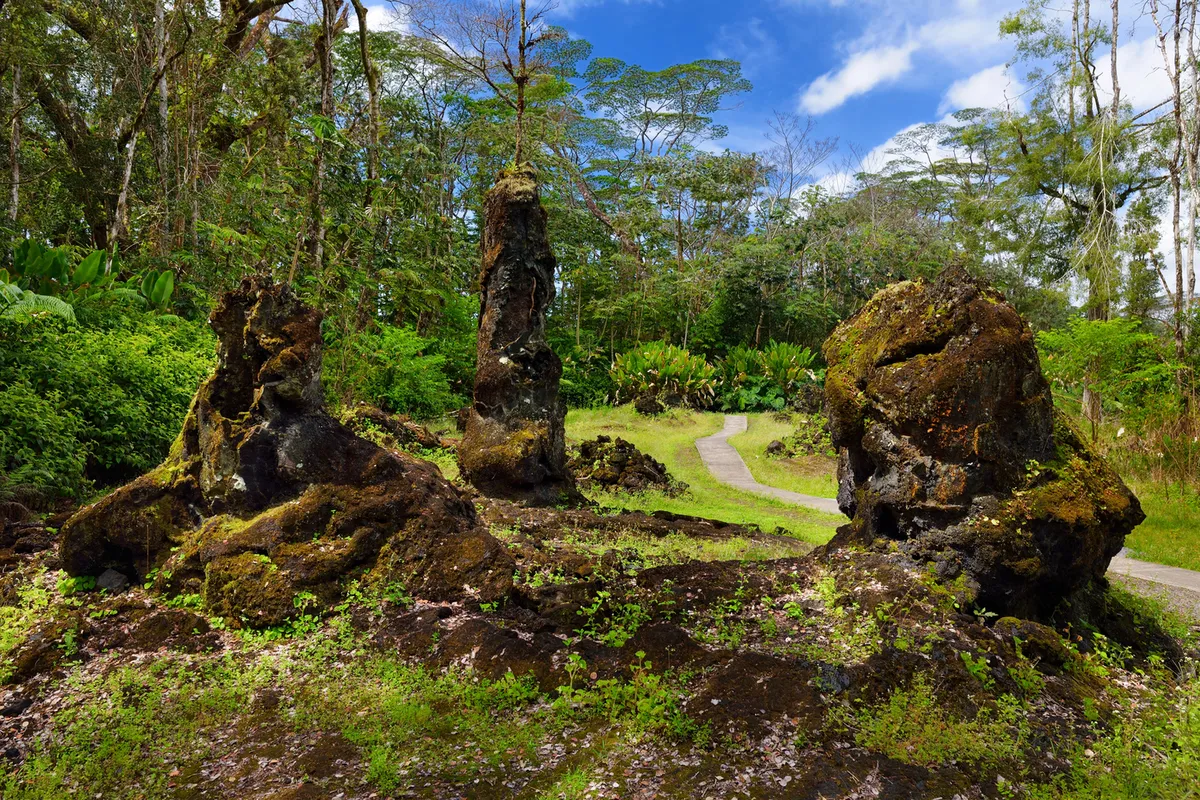
Walking here is like walking through a memory. The path winds through a landscape that is both beautiful and deeply unsettling, a testament to a power that is almost impossible to comprehend. These are not just geological oddities. They are markers of a profound story, one of destruction, creation, and the enduring spirit of this land.
Part I: The Whispering Forest of Stone
To understand the soul of Puna, you must first learn to listen to its silences. Here, in this 17.1-acre park, the silence speaks volumes, echoing a history written in fire and stone. The easy loop trail is more than just a walk. It's an introduction to the raw, untamable nature of Hawaiʻi Island.
A Guide to the Loop Trail
The main feature of Lava Tree State Monument is a paved 0.7-mile loop trail that offers an accessible and fascinating journey for visitors of all ages. The walk is gentle, but the landscape it traverses is anything but. The trail guides you through a forest that was flash-frozen in time, allowing you to get up close to these bizarre and beautiful formations.
The most impressive lava trees are near the park entrance, tall and well-defined, their surfaces a tapestry of dark lava rock and vibrant green moss. As you follow the path deeper into the monument, the forest canopy thickens, and the air grows cooler. Here, the lava molds are more weathered and broken, some appearing as little more than stumpy, hollowed-out mounds of rock. They look ancient, and they are.
🌋 How Lava Trees Form
These formations are the result of a specific and violent volcanic process. When a fast-moving, fluid lava flow—known as pāhoehoe—surged through this once-dense ʻōhiʻa forest, it moved so quickly that it enveloped the tree trunks. The intense heat of the lava, often exceeding 2,000 degrees Fahrenheit, met the cool, moist bark of the living trees. This contact created an insulating layer of steam, which caused the lava touching the tree to cool and harden almost instantly, forming a solid cast.
The trail is not just about the lava trees themselves. It is a walk through a regenerating Hawaiian rainforest. Towering ʻōhiʻa trees, their blossoms like fiery red pompoms, create a dense canopy overhead. Unfortunately, you will also see invasive species like the strawberry guava and the large-leafed cecropia tree, a reminder of the constant ecological battles being fought in Hawaiʻi's native forests.
Perhaps the most sobering feature of the park is right next to the parking lot: a massive, gaping fissure in the earth, a crack so deep that sunlight cannot find its bottom. A simple chain-link fence is the only thing separating you from a direct view into the island's volatile plumbing. It's a stark and immediate reminder that the forces that created this park are not dormant. They are very much alive.
The park provides basic amenities, including restrooms and covered picnic shelters, making it a comfortable stop for those exploring the Puna district. But the comfort of the facilities does little to diminish the profound sense of awe and unease the landscape inspires. The quiet here is not an absence of sound. It is the sound of a held breath, the pause after a cataclysm. It's a silence filled with the memory of a vibrant forest and the echo of the eruption that both destroyed and immortalized it.
Continue the Journey Through Time
Discover the dramatic history of the 1790 eruption that created these stone sentinels and changed Hawaiian history forever.
Part II: The Year the Sky Fell📖 Story Chapters
Current chapter
Historical tragedy
Part III: The 2018 EruptionModern witness
Part IV: The Enduring CyclePhilosophy & resilience
ℹ️ Visit Info
- Trail Length: 0.7 miles loop
- Difficulty: Easy/Accessible
- Duration: 30-45 minutes
- Entry Fee: Free
- Hours: Daylight hours
📍 Location & Safety
- Location: Highway 132, 2.7 miles SE of Pāhoa
- Safety: Stay on marked trails
- Hazard: Deep fissures - keep away from edges
- Weather: Can be wet and muddy
🎒 What to Bring
- Non-slip shoes (trail can be wet)
- Rain jacket or umbrella
- Insect repellent
- Camera for unique formations
- Water bottle