The Mission's History
From Humble Beginnings to Remarkable Rebirth

Written by a Local Expert
Jade KawanuiThe Early Years: A Mission is Born in Lahaina (1912-1932)
Against the backdrop of immigrant life, the Lahaina Jodo Mission was founded in 1912. Its beginnings were humble. The first mission was established within a private house on Maui's west side, created to serve the growing community of Japanese workers on the thriving plantations that dominated the landscape.
These workers needed a spiritual home. They needed a place where they could practice their faith, celebrate their traditions, and pass their culture to their children. The mission provided exactly that, becoming a cornerstone of the Japanese community in Lahaina.
For nearly two decades, the mission served its congregation from that modest location. But as the community grew, so did the vision for what the mission could become. In 1931, a momentous decision was made. The mission would move to a stunning new location at Puunoa Point on Ala Moana Street, just north of Lahaina's bustling Front Street.
This beachfront property was extraordinary. It offered sweeping views across the Auau Channel toward the neighboring islands of Lanai and Molokai. The West Maui mountains rose majestically behind it. The location felt both grounded and transcendent, perfectly suited for a place of spiritual practice.
By 1932, the final structure was complete. The simple wooden temple stood on land where sea breezes carried the scent of salt and plumeria, where the sound of waves provided a constant rhythm to daily practice. For over three decades, this temple would serve the community faithfully, witnessing births, deaths, marriages, and the slow transformation of plantation workers into established Hawaiian residents.
Trial by Fire: The 1968 Destruction and a Miraculous Rescue
For thirty-six years, the wooden temple at Puunoa Point stood as a spiritual home for Lahaina's Japanese Buddhist community. But in 1968, tragedy struck. A fire completely destroyed the original temple, consuming the building that had sheltered so much faith and so many memories.
This moment could have been the end of the mission's story. Instead, it became the catalyst for an extraordinary transformation. As flames engulfed the temple, something remarkable happened. The wife of the resident minister, Reverend Gensho Hara, made a split-second decision that would echo through decades. She ran into the burning building to save a precious wooden statue of Amida Buddha.
Think about that moment. The heat, the smoke, the danger. Yet she acted on faith and courage, emerging with the sacred statue clutched in her arms. That small wooden Buddha, rescued from flames by sheer determination, became a profound symbol of the mission's enduring spirit.
The story doesn't end there. That same wooden statue would survive another fire fifty-five years later. When the 2023 Lahaina wildfires swept through the mission grounds, destroying so much of the complex, that ancient rescued Buddha survived once again. A Japanese conservation team later restored it, preserving a piece of history that had survived two separate infernos across more than half a century.
Rebirth and Vision: The Centennial Project (1968-1971)
In the wake of the 1968 fire, the mission's members faced a choice. They could rebuild what was lost, creating another simple wooden temple. Or they could do something bolder, something that would stand as a lasting tribute to their heritage and their faith.
They chose the bold path. The congregation decided to create an authentic, grand-scale Japanese Buddhist temple complex. This was not just about replacing what burned. This was about making a statement of permanence, about honoring the legacy of the Issei, the first-generation immigrants who had sacrificed so much to build lives in Hawaii.
The timing made the project even more meaningful. The rebuilding was conceived as a centennial commemoration, marking one hundred years since the first Japanese immigrants arrived in Hawaii in 1868. Every element of the new complex would be a tribute to those pioneers and to the enduring strength of Japanese culture in the islands.
The ambitious project required tremendous resources. Mission members gave with generous and wholehearted support. The wider community rallied to help. A Japanese philanthropist named Masao Omori made a crucial contribution, donating the expertise of traditional Japanese craftsmen. These master artisans would ensure that every element of the new complex was authentic, built using traditional techniques and materials.
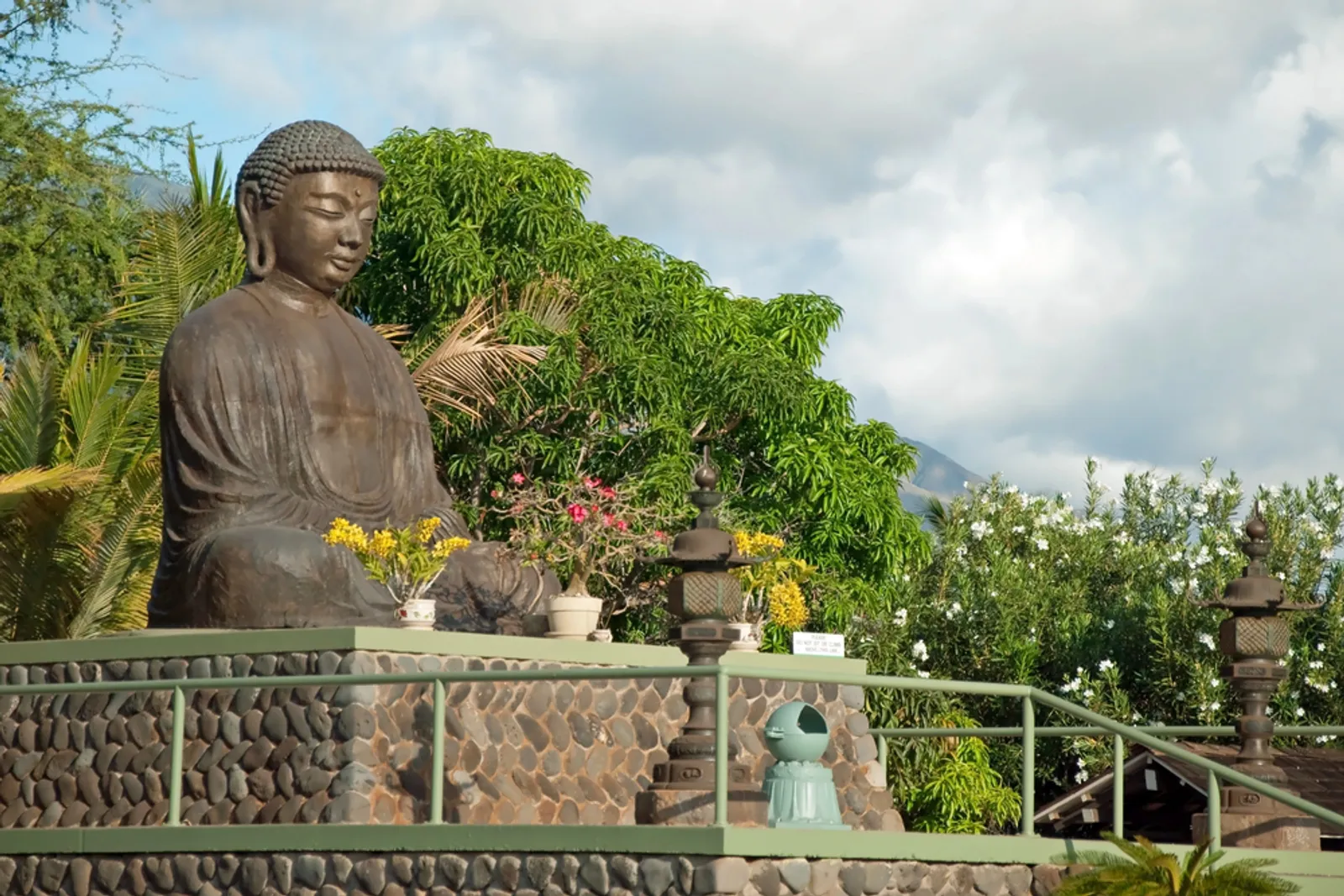
Work began immediately. The first elements to be completed were the Great Buddha and the Temple Bell. These magnificent pieces were finished and installed in June 1968, just in time for the centennial celebrations. Seeing these symbols rise from the ashes must have felt like a miracle to the congregation, a tangible sign that their faith and their community would not just survive but flourish.
The new main temple followed, built on the exact spot where the original had stood. The towering three-tiered pagoda came next. Construction continued through 1970 and into 1971, with craftsmen working carefully to ensure every detail honored traditional Japanese temple architecture.
When the complex was finally complete, it represented far more than the sum of its parts. The Lahaina Jodo Mission had been transformed from a local place of worship into one of Hawaii's most significant cultural landmarks. It stood as proof that from destruction could come beauty, that faith could fuel remarkable achievement, and that a community's determination could create something extraordinary.
This act of rebuilding established a precedent that resonates powerfully today. The mission had shown that resilience was not just a concept. It was a practice, a lived reality that could transform tragedy into triumph.
Continue Exploring
Discover the sacred structures and their profound meanings
📅 Timeline
- 1868: First immigrants
- 1912: Mission founded
- 1931-32: Moved to Puunoa
- 1968: Fire destroyed temple
- 1968-71: Rebuilt complex
- 2023: Wildfires struck
📖 Complete Guide
👥 Key Figures
- • Reverend Gensho Hara & wife (1968 rescue)
- • Masao Omori (Japanese philanthropist)
- • Traditional Japanese craftsmen from Kyoto
- • Lahaina Jodo congregation members