The Story of Molokini
From fire goddesses to a sanctuary reborn

Written by a Local Expert
Jade KawanuiA Volcanic Birth in the Deep Blue
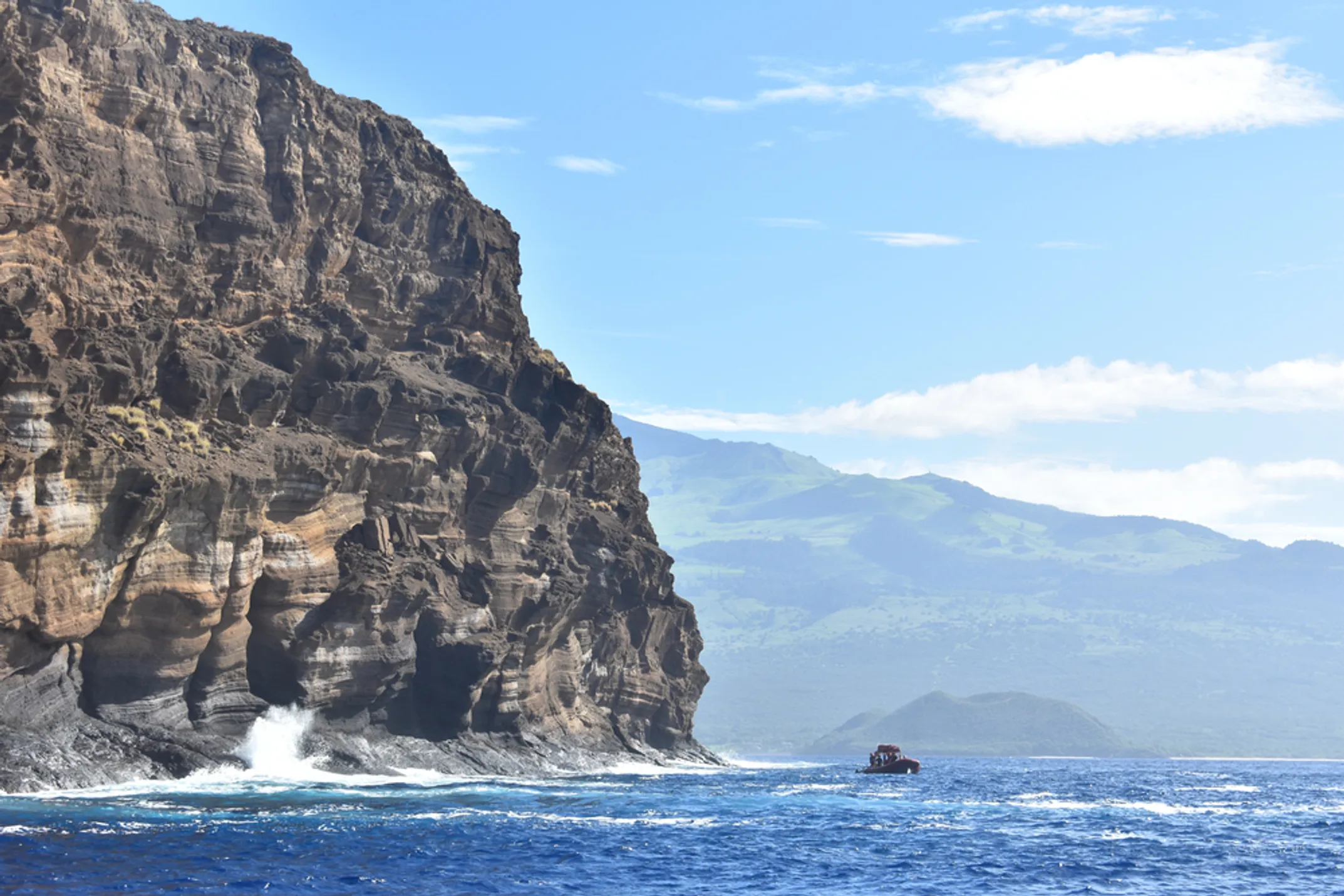
Molokini's story begins with fire and water. About 230,000 years ago, this tiny islet was born from a violent eruption along Haleakalā's southwest rift zone. This wasn't a gentle lava flow. It was what geologists call a phreatomagmatic eruption—a colossal steam explosion that occurred when superheated magma met the cold Pacific Ocean. The force of this blast shattered the molten rock into fine ash and volcanic glass before it could even form crystals.
This unique process is the secret behind Molokini's distinct appearance. While the cinder cones you see on Maui are reddish from oxidation, the rapidly cooled volcanic glass of Molokini breaks down into a dark, earthy yellow clay. This gives the crater its unique coloring. At its peak, the cone may have towered 500 feet above the sea. Over millennia, relentless wind and rain eroded the structure, causing its northern rim to crumble and sink beneath the waves.
This act of erosion was Molokini's making. The ocean streamed into the caldera, but the towering southern wall remained, creating a perfectly sheltered cove. It is this geological feature—a natural, crescent-shaped breakwater—that protects the inner waters from the open ocean's swell. This allows for the legendary calm and water clarity that make it such an incredible place to explore today. Inside this protected sanctuary, a vibrant coral reef began to grow, laying the foundation for the thriving ecosystem we see now.
Legends of the Islet: Pele's Fury and the Sacred ʻIewe
Hawaiian culture tells the story of the land not through geology, but through powerful moʻolelo (legends) and sacred chants. Molokini is no exception, and its stories offer layers of meaning.
The most famous legend is a dramatic tale of divine passion. The story goes that Molokini was a beautiful woman—or in some tellings, a powerful moʻo (a mythical lizard or dragon)—who fell in love with a mortal prince. Unfortunately, she had a rival for his affection: Pele, the formidable goddess of fire and volcanoes. Consumed by a jealous rage, Pele attacked the woman, splitting her in two with a single, fiery blow. Her body was transformed into the crescent-shaped islet of Molokini, while her severed head was cast ashore, becoming the red cinder cone you can still see today at Makena Beach, known as Puʻu Olai. This story serves as a powerful reminder of Pele's might and the sacred nature of the Hawaiian landscape.
However, there is a deeper, more intimate story found in ancient oral history. A sacred chant, or ʻoli, describes Molokini not as a product of rage, but of birth. It tells of Molokini being the ʻiewe (placenta) of the neighboring island of Kahoʻolawe. In this chant, Chief Uluhina cuts the newborn island's umbilical cord and casts the ʻiewe into the sea. In ancient Hawaiian tradition, burying the placenta connected a child to the land, but casting it into the ocean was done with the hope that the child would grow to be a great navigator and seafarer.
This act was deeply symbolic, as both Molokini and Kahoʻolawe lie near the Keala-i-Kahiki channel, the sacred "Pathway to Tahiti" that ancient Polynesian voyagers followed on their epic journeys across the Pacific. These two distinct stories show how the land is imbued with both the passionate dramas of the gods and a profound, genealogical connection to the Hawaiian people themselves.
A Modern History of Trial and Triumph
Molokini's modern history is as dramatic as its mythical origins. For centuries, it was a vital fishing ground for ancient Hawaiians, who navigated the channel to harvest its abundant marine life. Archaeologists have found evidence of this use, including ancient stone sinkers (pohakialoa) and fishing lures in the deep waters surrounding the islet.
This peaceful existence was shattered during World War II. The U.S. Navy, seeing the islet's unique shape as a perfect likeness of a battleship or submarine, began using Molokini for bombing practice. This, along with the overharvesting of its precious black coral in the following decades, inflicted severe damage on the delicate ecosystem. The destruction continued even after the war. In 1975 and again in 1984, the Navy detonated unexploded ordnance left over from the war, destroying huge swaths of the fragile coral reef.
These detonations, however, sparked public outrage and galvanized a powerful conservation movement. Divers, scientists, and locals fought to protect what was left of this natural treasure. Their efforts paid off. In 1977, the state of Hawaiʻi officially designated Molokini and the surrounding 77 acres as a Marine Life Conservation District, followed by its designation as a State Seabird Sanctuary. The vibrant, thriving reef you see today is not a given. It is a testament to a hard-won battle for preservation. It's a story of resilience, a powerful example of how a place, once scarred by destruction, can be reborn.
A Sacred Space: Understanding Molokini's Protected Status
When you visit Molokini, you are entering a strictly protected sanctuary. These rules aren't just suggestions. They are the very reason the crater remains one of the most pristine marine environments in Hawaii. Understanding and respecting them is part of the experience.
The strict protections are directly responsible for the incredible encounters visitors have. Because there has been no fishing or harassment for decades, the marine life has become habituated to the presence of snorkelers and divers. The fish don't see you as a threat, which is why they swim so freely and closely, creating the magical, immersive experience Molokini is famous for. By following the rules, you are not just obeying the law. You are actively participating in the preservation of the very magic you came to witness.
Marine Life Conservation District (MLCD)
The waters around Molokini were designated an MLCD in 1977, covering 77 acres of ocean and underwater terrain. The rules are simple but crucial:
Take Nothing, Leave Nothing
It is strictly forbidden to fish for, touch, take, or injure any marine life, including eggs. This also applies to non-living things. You cannot take or alter any sand, rocks, or coral from the district. Your presence should be as gentle as possible.
Do Not Feed the Fish
Feeding the fish is illegal and harmful. It disrupts their natural diet, can make them aggressive, and damages the delicate balance of the reef ecosystem.
No Anchoring
To protect the coral from devastating anchor damage, all commercial boats are required to use a system of permanent day-use moorings installed by the state.
State Seabird Sanctuary
While the underwater world gets most of the attention, the land of Molokini is just as important. The islet itself is a federally owned and state-protected seabird sanctuary, making it completely off-limits to visitors. You are not allowed to step foot on the crater under any circumstances.
This rocky outcrop provides a critical, predator-free nesting ground for thousands of seabirds. As you approach, you'll see them soaring overhead and nesting in the cliff faces. The most common residents are the Wedge-tailed Shearwaters ('ua'u kani), whose haunting calls give them their Hawaiian name, and the magnificent Great Frigatebirds ('iwa), which can often be seen riding the thermal updrafts above the crater. Admire them from the boat, and know that your distance is helping to protect future generations of these incredible ocean voyagers.
ℹ️ Quick Facts
- Age: 230,000 years
- Protected: Since 1977
- Area: 77 acres
- Status: MLCD & Sanctuary
📖 Guide Sections
📧 Maui Updates
Get the latest Molokini conditions and Maui adventure tips delivered to your inbox.