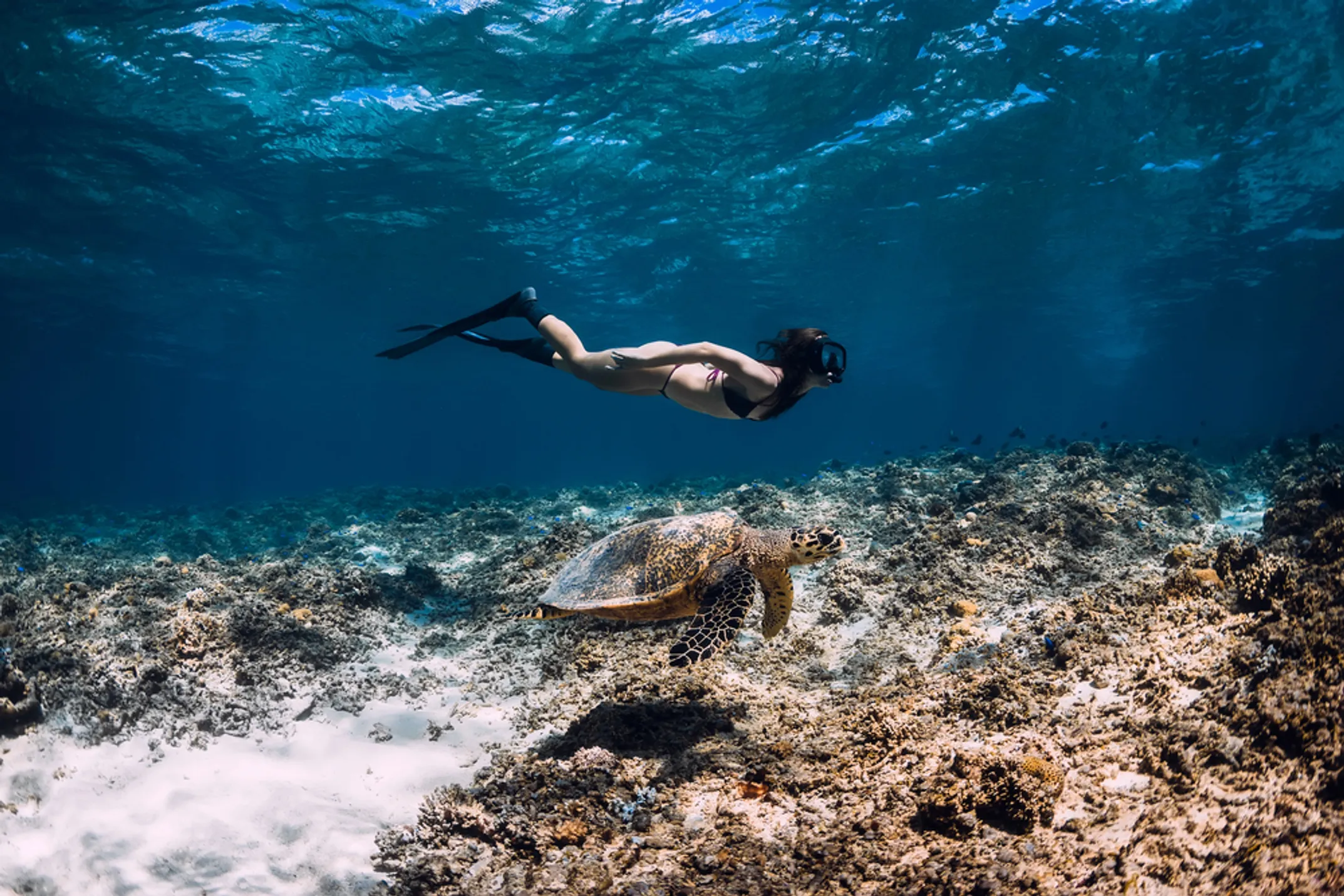
Deep Dive Kauai: A Scuba Diver's Paradise
From your first breath underwater to the legendary Forbidden Island
Written by a Local Expert
Leilani AkoWhile Kauai is famous for its snorkeling, its scuba diving is a well-kept secret that offers some of the most unique underwater experiences in Hawaii. For divers, Kauai presents a clear journey of progression. You can take your very first breath underwater on an easy shore dive, get certified in our warm waters, explore fascinating boat dives full of turtles, and ultimately, aspire to the world-class expedition to the "Forbidden Island" of Ni'ihau.
Getting Started: Your First Breath Underwater
Never tried scuba diving? Kauai is an incredible place to start. The PADI Discover Scuba Diving (DSD) program is a supervised experience designed for complete beginners with no certification. It's not a certification course, but rather an introduction to the underwater world. You'll start with a brief lesson on equipment and safety, practice a few essential skills in shallow water with a PADI professional, and then go on a guided dive to a maximum depth of 40 feet.
The premier location for these introductory dives is Koloa Landing on the South Shore, thanks to its easy, calm entry. The protected bay and sandy entry make it perfect for building confidence. Most DSD programs include all equipment, instruction, and a guided tour of the reef.
Reputable operators like Dive Kauai and Fathom Five Divers offer excellent DSD programs. These shops have been operating on Kauai for decades and understand local conditions better than anyone. Their instructors are patient, experienced, and committed to safety above all else.
If you get hooked (and you probably will!), you can get your lifetime PADI Open Water Diver certification right here on Kauai. The course typically involves online learning, skill practice in a pool or confined water, and four open water dives. Kauai's warm, clear water and abundant marine life make it an ideal place to learn.
Kauai's Premier Shore Dives
Koloa Landing (The "Turtle Airport")
Koloa Landing is the most popular and accessible shore dive on the island, beloved by divers of all skill levels. Entry is incredibly easy from an old boat ramp that slopes gently into the protected waters of Hanakaape Bay. The site is a large, U-shaped reef with a sandy bottom, offering plenty to explore on both the east and west walls.
The history of Koloa Landing adds another dimension to diving here. This was once a major port for sugar shipments in the 1800s, and you can still see remnants of the old pier structures underwater. These artificial reefs now provide additional habitat for marine life.
Dive Profile: With a maximum depth of about 45 feet and average visibility of 30-60 feet, it's a perfect site for new divers, photographers, and anyone looking for a long, relaxed dive. The gentle current and sandy bottom make navigation easy, while the abundant marine life ensures there's always something interesting to see.
Marine Life: This place is nicknamed the "turtle airport" for a reason—it's a primary resting area for our honu, and you are almost guaranteed to see them. Koloa Landing is also famous for its incredible diversity of moray eels; it's not uncommon to spot five or six different species on a single dive, including the rare and beautiful Dragon Moray.
Keep your eyes peeled for octopus, well-camouflaged frogfish, and in the winter months, you can often hear the haunting songs of humpback whales echoing through the water. The site also hosts cleaning stations where turtles and fish come to be serviced by cleaner wrasse and tangs.
Macro photographers love Koloa Landing for its small critter diversity. Nudibranchs, leaf scorpionfish, and juvenile fish provide endless subject matter. The sandy areas between coral heads often hide flatfish and rays buried in the substrate.
My Insider Tip: Koloa Landing is my go-to spot for a relaxing, life-filled dive. The reef on the west side (to your right as you enter) is my personal favorite. Look closely in the coral rubble for the elusive frogfish—they are absolute masters of camouflage! The early morning dives here are magical, with better visibility and more active marine life.
Black Rock (Kauai's Hidden Gem)
Located on the South Shore between Poipu and Lawai, Black Rock offers excellent shore diving when conditions allow. The site features a dramatic underwater landscape of ancient lava formations that create caves, arches, and swim-throughs.
What makes Black Rock special is its diversity of dive experiences within a single site. Shallow areas perfect for new divers give way to deeper walls suitable for advanced divers. The varied topography supports different marine communities, from shallow-water angelfish to deeper-dwelling groupers.
Entry requires navigating rocky shoreline, making this site best suited for experienced shore divers. But those willing to make the effort are rewarded with some of Kauai's best underwater scenery and marine life diversity.
Kauai's Best Boat Dives (For Certified Divers)
Sheraton Caverns
Just a short boat ride from Poipu, Sheraton Caverns is one of Hawaii's most famous dive sites. It's not a true cavern system, but rather a series of massive, collapsed lava tubes that have created a stunning underwater landscape of archways, ledges, and large swim-throughs.
The geological forces that created Sheraton Caverns are fascinating. Ancient lava flows cooled and hardened on the surface while molten lava continued flowing underneath, creating hollow tubes. Over time, sections collapsed, forming the dramatic openings divers explore today.
Dive Profile: This is a fantastic boat dive for all certified divers, with depths ranging from 35 to 70 feet. Visibility is often excellent, typically between 60 and 100 feet. The site features multiple dive levels, allowing divers to explore according to their certification and comfort level.
Marine Life: The caverns provide shelter for an incredible amount of marine life. This is one of the best places to see large green sea turtles and white-tip reef sharks resting peacefully under the lava ledges. The nooks and crannies are also home to eels, octopus, and colorful nudibranchs.
Eagle rays occasionally glide through the larger openings, and schools of soldierfish create living curtains in the darker recesses. The contrast between the bright blue water outside and the shadowy interiors of the caverns creates dramatic photographic opportunities.
Hale o Honu (House of the Turtles)
This site offers a truly unique glimpse into the underwater ecosystem. Its claim to fame is a "turtle cleaning station," a specific coral head where Hawaiian Green Sea Turtles congregate for grooming services provided by various fish species.
The Experience: As a diver, you get to witness a fascinating symbiotic relationship firsthand. Surgeonfish establish a "station" on the reef, and turtles line up to have the fish pick algae and parasites off their shells. It's an incredible behavior to observe, as generations of turtles return to this exact spot for their spa day.
The cleaning behavior at Hale o Honu represents millions of years of evolutionary cooperation. The fish benefit from a reliable food source, while turtles maintain healthy shells and remove parasites. Watching this ancient ritual unfold never gets old.
Dive Profile: With calm conditions and depths from 20 to 65 feet, this site is accessible and enjoyable for most certified divers. The coral formations provide excellent navigation references, and the predictable turtle behavior makes wildlife encounters almost guaranteed.
Marine Life: While the turtles are the main event, the reef is also home to octopus, lionfish, and a variety of angelfish. It's also one of the few places on Kauai where you might get a lucky sighting of the critically endangered Hawksbill sea turtle.
General Store
One of Kauai's most unusual dive sites, General Store gets its name from the incredible diversity of marine life found here. Like a general store that stocks everything you might need, this site seems to host every fish species found in Hawaiian waters.
The underwater topography features a series of coral ridges and sandy channels that create diverse micro-habitats. Each zone supports different species, from shallow-water specialists to deeper-dwelling fish that venture up to feed.
Advanced divers can explore the deeper sections where larger pelagic species occasionally appear. Barracuda, jacks, and even occasional shark sightings make this site exciting for experienced divers seeking encounters with bigger marine life.
The Ultimate Dive: The Forbidden Island & Lehua Crater
For experienced divers seeking a true adventure, the trip to Ni'ihau is the pinnacle of Hawaiian diving. This isn't just a dive; it's an expedition to a remote and wild underwater paradise that few people ever experience.
The Destination: Ni'ihau, located 17 miles southwest of Kauai, is a privately owned island that is almost entirely untouched by the modern world, earning it the nickname "The Forbidden Island." The diving takes place in the pristine waters offshore and at Lehua Crater, a dramatic, crescent-shaped volcanic tuff cone that is a state seabird sanctuary.
The isolation of Ni'ihau has preserved its marine ecosystem in a near-pristine state. Without coastal development, agricultural runoff, or significant human impact, the reefs around Ni'ihau represent what Hawaiian marine environments looked like centuries ago.
The Experience: This is a full-day adventure that begins with a 2 to 3-hour boat crossing over the often-rough Kaulakahi Channel. The reward for the journey is access to some of the most remote and vibrant dive sites in the entire state, with visibility that can exceed an astonishing 150 feet.
Dives here are often drift dives along sheer vertical walls in strong currents, which is why it's reserved for advanced divers. The current brings nutrient-rich water that supports large populations of pelagic species rarely seen around the more populated islands.
Marine Life (The Main Event): This is where you go to see the big animals. The deep, clear, nutrient-rich water attracts an incredible array of life. Encounters with the critically endangered Hawaiian Monk Seal are very common here—they are often curious and will swim by to investigate divers.
You can also expect to see large schools of pelagic fish, manta rays, eagle rays, and several species of sharks, including Galapagos and white-tips. The underwater topography around Lehua Crater creates upwelling currents that attract open-ocean species usually seen only in deep water.
Spinner dolphins frequently approach boats during surface intervals, and whale sightings during winter months are common. The pristine coral formations support dense populations of tropical fish species, creating underwater landscapes that seem almost too vibrant to be real.
Requirements: This is non-negotiable and for your safety. All dive operators require divers to have an Advanced Open Water certification (or equivalent) due to the depth (dives often range from 60-100+ feet) and challenging open-ocean conditions. You will need to show proof of your certification.
The advanced certification requirement isn't arbitrary. Ni'ihau diving involves strong currents, deep profiles, and remote locations where help isn't readily available. Divers need proven skills in buoyancy control, underwater navigation, and emergency procedures.
My Insider Tip: A trip to Ni'ihau is a pilgrimage. It's only possible during the calm summer months (May-September), and even then, trips are often cancelled due to rough seas. If you are an advanced diver and have the opportunity, do not hesitate. The moment a curious monk seal swims by to check you out in that impossibly deep blue water is a memory that will stay with you forever.
Continue Your Underwater Journey
Complete your guide to Kauai's underwater world
🤿 Dive Sites
- Koloa Landing
Shore dive, all levels
- Sheraton Caverns
Boat dive, certified divers
- Ni'ihau
Advanced only, summer only
📜 Getting Certified
- Discover Scuba:
No certification needed
- Open Water:
Get certified on Kauai
- Advanced:
Required for Ni'ihau
⚓ Top Operators
- Dive Kauai
Comprehensive packages
- Fathom Five Divers
Small group experiences
📖 Guide Navigation
⚠️ Dive Safe
Always dive with a buddy. Check your equipment. Know your limits. Respect marine life.