Planning Your Visit
Everything You Need to Know for an Unforgettable Experience
Written by a Kauaʻi Historian
Kalani MillerWhen to See What: Your Wildlife Calendar
Different species follow their own seasonal rhythms at Kīlauea Point. Understanding these patterns helps you plan the perfect visit based on what you most want to see.
Laysan Albatross (November-July)
November-December: Courtship dances peak
January-June: Nesting and chick rearing
July: Dramatic fledging season
Hawaiian Goose (Year-round)
November-April: Nesting season peaks
Winter-Spring: Goslings appear most often
Red-footed Booby (Year-round)
February-April: Nesting peaks
Summer: Chicks visible in nests
Humpback Whale (November-April)
January-March: Peak viewing period
Watch for breaching, tail slapping, and spouting from cliffs
Red-tailed Tropicbird (February-October)
Spectacular aerial courtship displays throughout breeding season
Wedge-tailed Shearwater (March-November)
Return to cliffside burrows around dusk for best viewing
The Living Landscape: Healing the Land
The vibrant green landscape represents dedicated effort to heal and restore native ecosystems that support wildlife. When the refuge was established, invasive plants like Christmas berry and ironwood crowded out native species.
The Nihoku Ecosystem Restoration Project, launched in 2012, built a two-mile predator-proof fence to protect ground-nesting birds from cats, dogs, and rats. Inside this protected area, crews removed acres of invasive vegetation and planted over 16,000 native plants representing more than 30 species. This isn't just landscaping. It's ecological healing, recreating thriving coastal habitat that existed for centuries.
Plants with Purpose
Each plant along the lighthouse path has a story and purpose. This habitat architecture directly serves wildlife needs.
ʻĀheahea
Red-footed Boobies prefer lining nests with these leaves, which wilt to create humid incubation environments.
ʻAkoko
Look under these sprawling shrubs for hidden Wedge-tailed Shearwater burrows.
Hala
Pacific icon providing leaves for lau hala weaving. Nēnē geese feed on the starchy fruit "keys."
ʻIlima
Coastal shrubs with delicate yellow-orange flowers. Takes 1,000 blossoms for a single dense lei.
Naupaka
Hardy coastal plant with distinctive half-flowers helps stabilize soil closest to the ocean.
Essential Visitor Information
Hours & Fees
Hours: Wednesday through Saturday, 10:00 AM to 4:00 PM. Last entry at 3:30 PM. Closed all major federal holidays.
Fees: $10 per adult (16+) plus $1 non-refundable reservation fee. Children 15 and under are free and don't need reservations.
How to Book
Reservations are required for all visitors 16 and older. Visit Recreation.gov or download their mobile app. Search for "Kilauea Point National Wildlife Refuge," select "Kilauea Point Ticketed Entry," and choose your date and time. You can book up to 60 days in advance.
Passes: America the Beautiful passes, Kamaʻāina Pass, and Federal Duck Stamps are honored. Pass holders must still make reservations and pay the $1 booking fee. One pass admits the cardholder plus three other adults.
What to Bring
- • Binoculars are essential for close-up wildlife viewing. The refuge sometimes has loaners, but bring your own to be sure.
- • Camera with good zoom will capture memories
- • Sun protection is crucial since there's little shade on the point
- • Light rain jacket for changing North Shore weather
Getting There
From Līhuʻe, drive north on Kūhiō Highway (Hwy 56) for 23 miles to Kīlauea town. Turn right on Kolo Road, then left on Kīlauea Road. Follow it two miles to the refuge entrance. Walking or biking into the refuge isn't permitted due to safety concerns and the narrow road. You must arrive in a vehicle.
From parking, it's a pleasant five-minute walk along a paved path with slight uphill grade to the lighthouse and main viewing area. Golf carts are available for visitors needing assistance. Stop by the Visitor Center near the entrance for educational displays and knowledgeable staff conversations.
Visiting with Respect
Don't feed wildlife. This is the most important rule. Feeding Nēnē and other animals makes them lose natural fear of humans and cars, often resulting in death. It's also illegal.
Keep your distance. Stay on marked trails and maintain respectful distance from federally protected wildlife. Stay at least 60 feet (four car-lengths) away.
Leave no trace. No food or drink except water is allowed past the visitor center. Pack out everything you bring in.
Photography Spots and Pro Tips
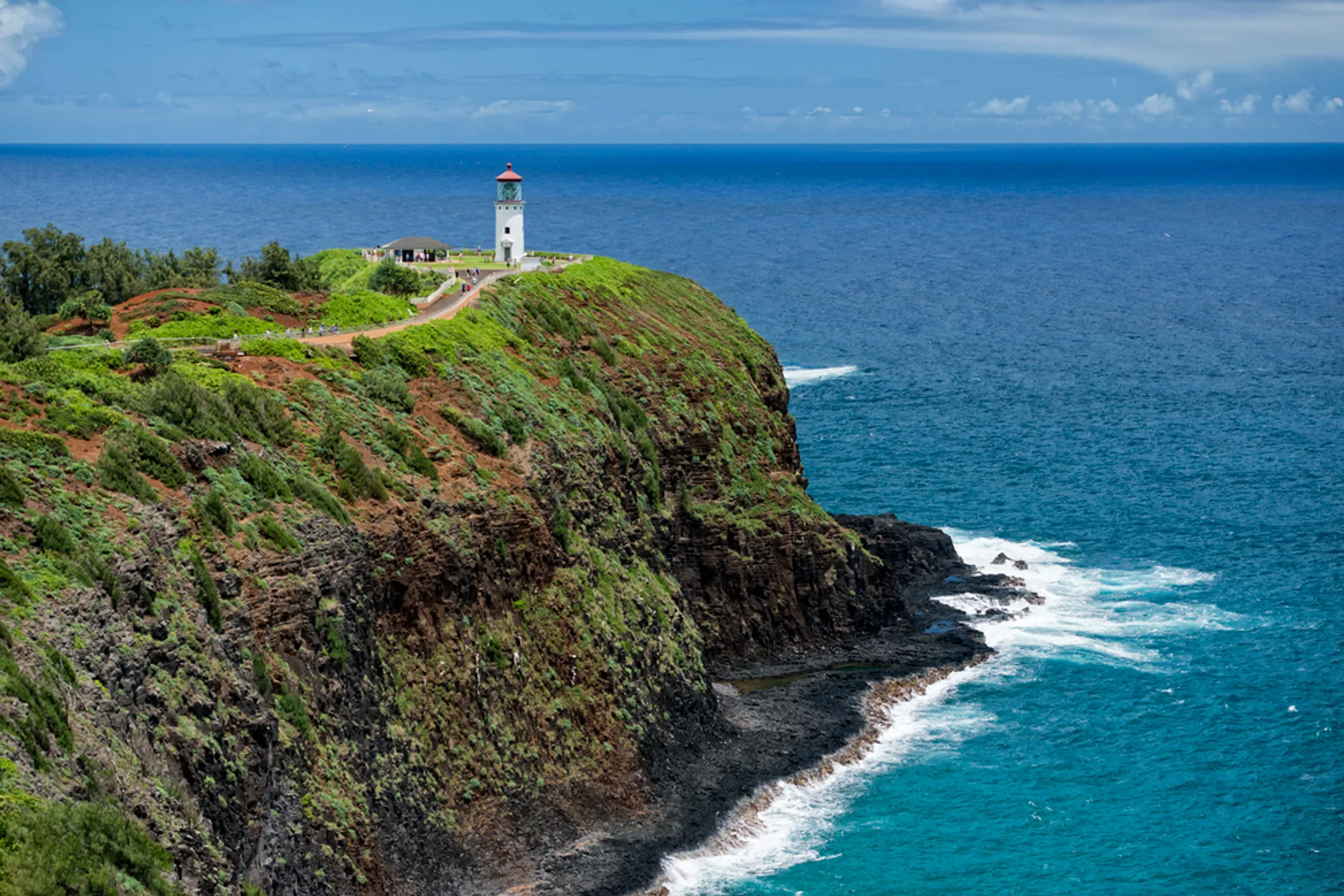
The main overlook past the visitor center offers classic panoramic shots of lighthouse against coastline that have graced countless calendars and travel magazines. Early morning light illuminates the white tower against deep blue ocean, while late afternoon sun creates warm golden tones on the historic concrete.
The paved path to the point provides incredible, unobstructed cliff views perfect for capturing birds in flight against blue ocean. Telephoto lenses work best for wildlife photography. A 400mm lens or longer will allow you to capture intimate behavioral moments without disturbing the animals.
For whale photography, scan the horizon constantly and be ready to shoot quickly. Breaches happen without warning and last only seconds. Bird photography requires patience and understanding of behavioral patterns. Albatross courtship displays follow predictable sequences, allowing experienced photographers to anticipate peak moments.
Beyond the Lighthouse: Exploring Kīlauea Town
Your refuge visit anchors a perfect North Shore day. Historic Kīlauea Town, a former sugar plantation hub, has blossomed into a delightful community with laid-back vibes.
Stop by historic stone buildings at Kong Lung Market Center for boutique shopping and art galleries. Grab a famous ʻahi wrap at Kīlauea Fish Market or healthy juice from Kauaʻi Juice Co. The Wai Koa Loop Trail offers a gentle five-mile walk through forests past the historic Kīlauea Stone Dam.
Further afield, legendary Hanalei Bay awaits with its two-mile crescent of sand and stunning mountain backdrop. For spectacular beaches and snorkeling, plan ahead for Hāʻena State Park. Access is limited and requires advance reservations.
A Living Legacy
Kīlauea Point weaves together multiple stories that span centuries and connect past to future in ways that few places on earth can match. It's a beacon of history, having guided mariners through treacherous waters, saved aviators from certain death, and witnessed the transformation from war to peace. It's a world-class sanctuary, a protected stage where magnificent and rare creatures perform the eternal dramas of survival, courtship, and renewal. It's proof of community power to preserve heritage against the forces of time and neglect. And it's a place of deep cultural resonance where land, plants, and animals interweave with Hawaiian identity in patterns older than written history.
When you visit, you become part of this ongoing story. You become a keeper of the light by visiting with respect, learning its history, and carrying its story forward to others who might never see this place themselves.
Your footsteps join those of lighthouse keepers, scientists, conservationists, and countless other visitors who have been transformed by this place. You add your voice to the chorus of advocates who understand that some places are too important to lose. You become part of a community that spans generations and cultures but shares a common commitment to preserving paradise.
The trade winds will carry your story too, mixing it with all the others that make this place so special. Come with an open heart ready to listen. Come prepared to be changed by what you discover. Come knowing that you'll leave a little different than when you arrived, carrying pieces of this place that will stay with you forever.
Listen to what the land has to teach. Watch the birds and learn their names. Study the flowers and understand their purposes. Feel the wind and know that it connects you to every other living thing on these islands. Leave knowing you've touched something eternal on the edge of paradise, something worth protecting for children not yet born.
The stories continue. The lighthouse keeps its silent watch. The birds return each season. The whales sing their ancient songs.
Mālama pono. Take care of this place, and it will take care of you.
Explore the Complete Story
Discover the full history and heritage of Kīlauea Point Lighthouse.
💡 Insider Tips
- Morning visits often have calmer weather and more active wildlife
- Late afternoon light is magical for photography
- Book after 1:00 PM to avoid crowds
- Bring your own binoculars - loaners may not be available
🗺️ Nearby Attractions
- Kong Lung Market Center
- Kīlauea Fish Market
- Wai Koa Loop Trail
- Hanalei Bay
- Hāʻena State Park
📖 Complete Guide
Built by hand & heart
Rescue & RestorationAviation rescue & Senator Inouye
Wildlife ParadiseBirds, whales & marine life
Current page