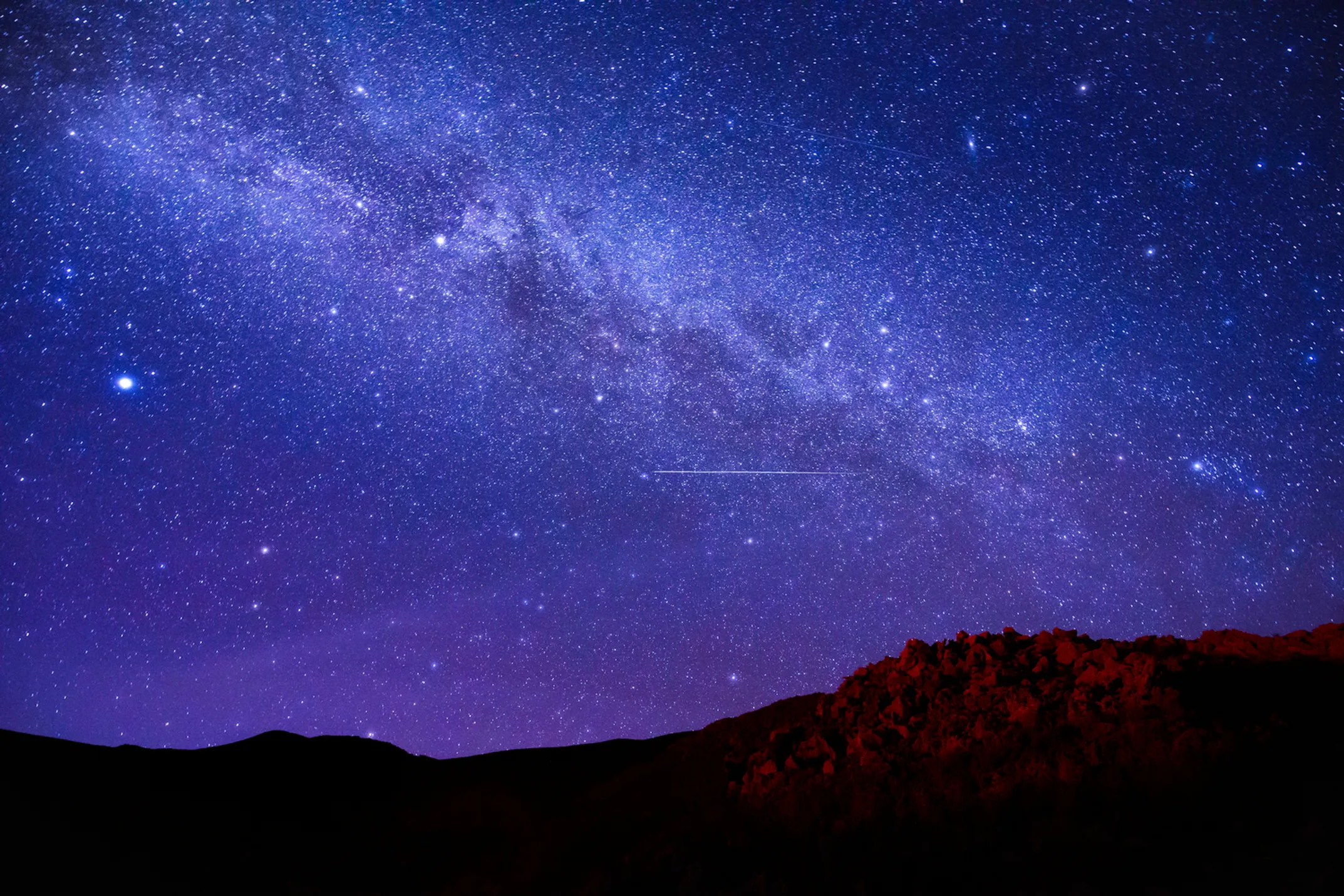
The Soul and Science of the Stars
Why Hawaiʻi offers the world's most spectacular window to the cosmos

Written by a Local Expert
Kalani MillerTwo Worlds Meeting: Modern Science and Ancient Wisdom
To truly appreciate why stargazing here is so special, you have to understand two worlds meeting. The world of modern science and the world of ancient wisdom. Both look to the same sky from the same land. Both find it to be a place of unmatched significance.
The Science: A Perfect Window to the Cosmos
Modern astronomers chose the Big Island for their billion-dollar telescopes for very specific reasons. Our island is a natural observatory. It's blessed with a unique combination of conditions found almost nowhere else on Earth.
🏔️ High Altitude
At nearly 14,000 feet, Maunakea's summit rises above 40% of our planet's atmosphere and 90% of its water vapor. Less stuff between you and the stars means clearer, sharper views.
🌊 Atmospheric Stability
Air flowing over the vast Pacific Ocean is incredibly smooth and stable. This lack of turbulence allows for high-resolution images with minimal "twinkling."
🌌 Minimal Light Pollution
Surrounded by thousands of miles of ocean, the Big Island is one of the most isolated landmasses on the planet, creating profoundly dark skies.
🌍 Complete Sky View
Our location near the equator allows us to see nearly all stars in both Northern and Southern celestial hemispheres—a complete view of the heavens.
These factors combine to create what is widely considered the best site for astronomy on the planet. We get up to 300 clear nights a year.
The Soul: Kilo Hōkū – The Star-Watchers of Ancient Hawaiʻi
Long before modern telescopes arrived, our ancestors were master astronomers. For ancient Polynesians, the sky was not just a thing of beauty. It was a map, a calendar, and a survival tool. The kilo hōkū, or star-watchers, were among the most revered members of society. They possessed deep, scientific knowledge passed down through generations.
This knowledge was most famously applied in wayfinding. The art of navigating the open ocean without instruments. These were not voyages of chance. They were precise, calculated journeys across thousands of miles of trackless ocean. This was made possible by a holistic understanding of the natural world.
The Hawaiian Star Compass
At the heart of this practice was a mental model now known as the Hawaiian Star Compass. This isn't a physical object but a sophisticated mental construct. It was famously articulated by modern master navigator Nainoa Thompson of the Polynesian Voyaging Society. The navigator visualizes the horizon as a circle divided into 32 "houses." Each house represents a specific bearing where a celestial body—a star, the sun, the moon—will rise in the east and set in the west.
By memorizing the paths of hundreds of stars through these houses, a navigator could maintain a precise course. For example, to determine latitude when sailing north to Hawaiʻi, they would observe the Southern Cross. At the latitude of Hawaiʻi, the distance from the top star of the cross to the bottom star is the same as the distance from the bottom star to the horizon. A unique celestial signature.
Ancient Navigation Tools
- Star positions: Rising and setting points of specific stars for precise bearings
- Ocean swells: Direction and patterns of deep ocean waves
- Wind patterns: Seasonal trade winds and local variations
- Bird flight paths: Migratory patterns indicating nearby land
This tradition is not just history. It is a living, breathing culture, carried on today by the voyages of the Hōkūleʻa. A traditional double-hulled sailing canoe that continues to navigate the Pacific using these ancient methods.
📊 Amazing Facts
- Clear Nights: 300+ per year
- Summit Elevation: 13,803 feet
- Atmosphere Above: Only 60%
- Water Vapor Above: Only 10%
- Telescopes: 13 observatories
🧭 Navigation Stars
- Mānaiakalani Maui's Hook
- Hokulea Arcturus
- Na Kau Southern Cross
- Hokupa'a North Star
The Sacred: Maunakea, the Piko of Hawaiʻi
To speak of the stars in Hawaiʻi is to speak of Maunakea. And to speak of the mountain, we must do so with understanding and respect. In the cultural context, you will see me and others use the single-word spelling Maunakea. This is the proper name for this sacred mountain. The two-word "Mauna Kea" is a more generic term that can mean any white mountain.
Maunakea's significance goes far beyond its height. In Hawaiian cosmology, it is the first-born son of Wākea and Papahānaumoku. The Sky Father and Earth Mother. The progenitors of the Hawaiian people. It is considered a genealogical ancestor. The sacred piko—or umbilical cord—that connects the Hawaiian people to the divine heavens.
The summit is a wao akua, the realm of the gods. Traditionally, this was a place so sacred that only the highest-ranking aliʻi and kahuna were permitted to ascend for important rituals.
The mountain is home to many deities. Most famously Poliʻahu, the goddess of snow, whose icy mantle often covers the summit. It is also a landscape rich with cultural sites. This includes burial grounds, shrines, and the sacred Lake Waiau. One of the highest lakes in the world.
For this reason, anyone visiting the mountain should practice mālama i ka ʻāina—caring for the land. This means approaching with reverence. Never moving rocks or leaving offerings unless you are a cultural practitioner following specific protocol. Understanding that you are a guest in a place of immense spiritual power. When you visit, remember that you are not just on a mountain. You are in a temple.
Respectful Visiting Protocol
- Approach with reverence: Remember you are visiting a sacred place
- Don't disturb the land: Never move rocks or take anything as souvenirs
- No offerings: Unless you are a cultural practitioner following specific protocol
- Stay on designated paths: Protect fragile ecosystems and cultural sites