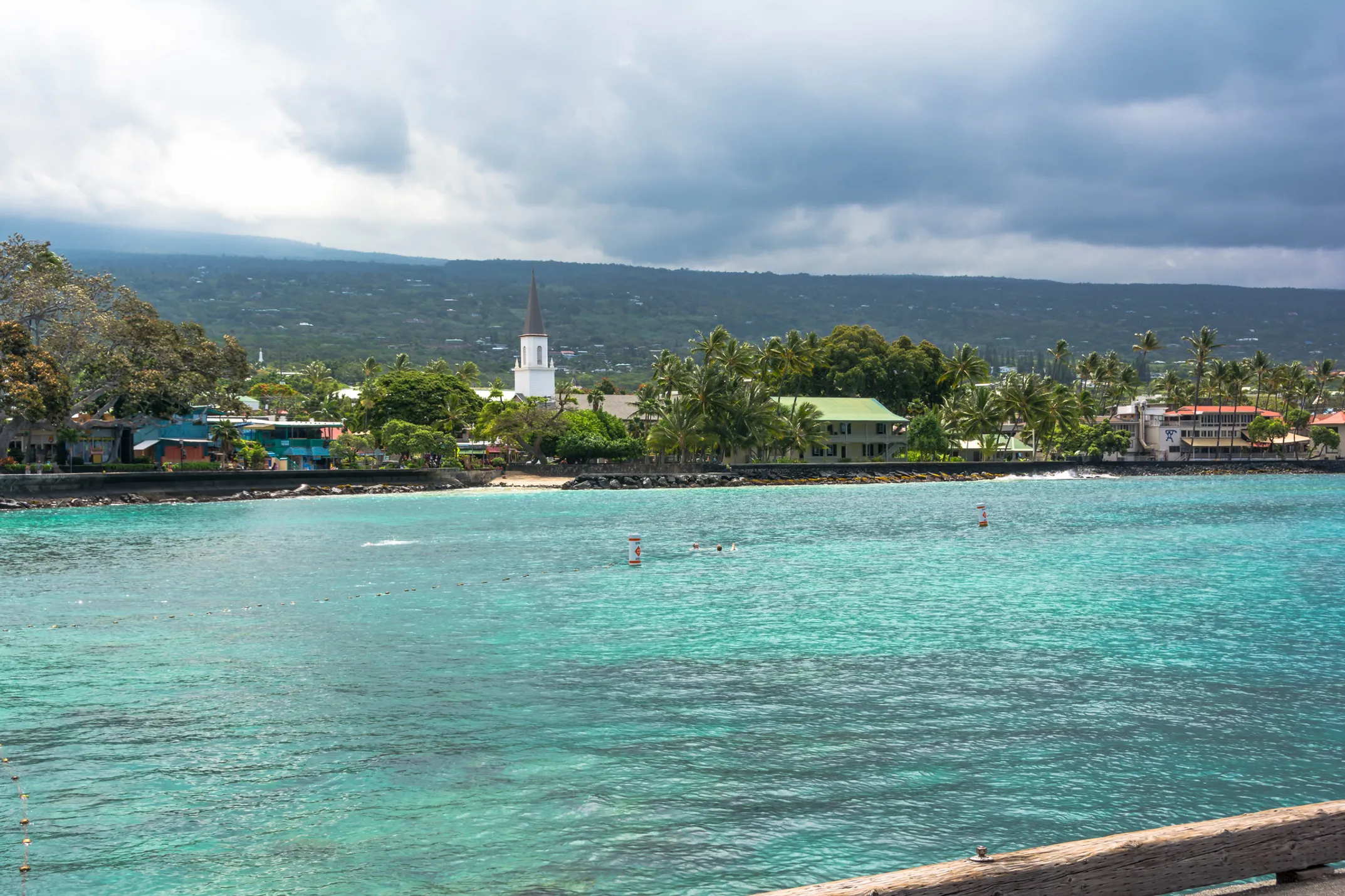
Royal History
The royal heart of Kona where Hawaiian monarchy shaped history
Written by a Local Expert
Kalani MillerThe Royal Heart of Kona: A Journey Through History
To truly appreciate Kailua Bay, you must understand its royal past. The "Historic Triangle" is not just a collection of old buildings. It's a narrative of power, faith, and cultural evolution, all within a few hundred feet of each other.
From the pier, a short walk across Aliʻi Drive transports you into the heart of three centuries of Hawaiian history. This compact area, which I call the "Historic Triangle," holds a palace, a church, and a sacred temple, each representing a distinct era of Kona's past. Standing here, you are looking at a physical timeline of the immense cultural shifts that took place in 19th-century Hawaiʻi. It's a visual narrative of collision, adaptation, and transformation. You can see a thousand years of history without taking more than a hundred steps.
Standing in the Historic Triangle, you witness the convergence of three worlds: ancient Hawaiian spirituality, Christian faith, and royal Hawaiian culture adapting to a changing world.
Timeline of the Historic Triangle
| Site | Built/Restored | Key Figure(s) | Historical Significance |
|---|---|---|---|
| Ahuʻena Heiau | Restored 1812 | King Kamehameha I | The center of political & spiritual power in the unified kingdom; temple to Lono |
| Mokuʻaikaua Church | Completed 1837 | Rev. Asa Thurston, Gov. Kuakini | Hawaiʻi's first Christian church; symbolizes the arrival of Western influence and religion |
| Huliheʻe Palace | Built 1838 | Gov. Kuakini, Princess Ruth, King Kalākaua | A royal vacation retreat showcasing the monarchy's blend of Hawaiian heritage and Western lifestyle |
Ahuʻena Heiau: Temple of a Unifying King
The Sacred Foundation of the Kingdom
Just steps from the soft sand of Kamakahonu lies one of the most historically significant sites in all of Hawaiʻi: Ahuʻena Heiau. This reconstructed temple stands with quiet dignity at the water's edge, its thatched roofs and carved kiʻi (statues) a stark and beautiful contrast to the modern hotel behind it. This was the personal temple and final residence of King Kamehameha I, the great unifier of the Hawaiian Islands. From this very spot, he governed his kingdom from 1812 until his death in 1819.
Sacred Purpose
The heiau was dedicated to Lono, the god of peace, agriculture, and prosperity. It was also the stage for one of the most pivotal moments in Hawaiian history: the overthrow of the ancient kapu (taboo) system.
Political Center
This sacred site was more than just a temple. It was the White House of its day. Here Kamehameha held council with his chiefs and personally trained his son Liholiho to rule after him.
Historical Moment:
This act, which occurred shortly after Kamehameha's death, dismantled the old religion and reshaped Hawaiian society forever. The relationship between the sacred heiau and the adjacent hotel is a fascinating example of how modern tourism and ancient culture can coexist.
Huliheʻe Palace: Stories from a Royal Retreat
Where Hawaiian Royalty Lived and Loved
Huliheʻe Palace is the elegant former summer home of Hawaiian royalty. Built in 1838 from local lava rock by Governor John Adams Kuakini, it became a favorite retreat for the aliʻi. It's a place filled with stories. The palace walls hold the stories of some of Hawaiʻi's most fascinating royal figures.
👸 Princess Ruth Keʻelikōlani: The Defender of Tradition
Princess Ruth Keʻelikōlani was a force of nature. As governor of Hawaiʻi Island and one of the wealthiest women in the kingdom, she was a powerful aliʻi who fiercely defended Hawaiian traditions. Though she was educated in English, she famously conducted all official business in the Hawaiian language.
A Powerful Statement:
Despite owning the beautiful two-story palace, she often preferred to live and sleep in a traditional hale pili (grass house) she had built on the palace lawn—a clear and powerful statement about her identity and her connection to the ways of her ancestors.
🎭 King Kalākaua: "The Merrie Monarch"
King Kalākaua, known as "The Merrie Monarch" for his love of music, dance, and celebration, saw Huliheʻe as a lavish vacation getaway. He and Queen Kapiʻolani hosted grand parties and galas here.
Victorian Transformation:
It was Kalākaua who gave the palace its more refined, Victorian-era appearance by having the original lava rock walls plastered over and furnishing it with elegant pieces from his world travels. The museum you see today is largely a reflection of his opulent era.
Today's Palace:
The palace is filled with beautiful furniture and artifacts from royal travels, many of which are on display today, including intricate koa wood pieces and some of Kamehameha the Great's own war spears.
Mokuʻaikaua Church: A Foundation of Stone, Coral, and Faith
Where New England Met Native Hawaii
Directly across the street stands Mokuʻaikaua Church, a handsome stone building with a 112-foot steeple that remains the tallest structure in Kailua-Kona. As Hawaiʻi's first Christian church, completed in 1837, it represents the arrival of Western religion and a new spiritual paradigm.
The story of Mokuʻaikaua Church is a masterclass in cultural fusion. Its design is that of a classic New England meeting house, a style brought by the first American missionaries. But its soul is purely Hawaiian.
Construction: A Story of Cultural Blending
Hawaiian Materials
- • Lava Rock: Local stone for thick walls
- • Coral Mortar: Crushed and burned coral binding
- • Koa Wood: Prized timber for pews and pulpit
- • ʻŌhiʻa Beams: Sacred wood for entire internal frame
Cultural Significance
- • New England Design: Meeting house architecture
- • Hawaiian Craftsmanship: Traditional building techniques
- • Sacred Stones: Some sourced from nearby heiau
- • 50-foot Beams: Spanning entire building width
🌺 The Sacred ʻŌhiʻa Story
Most significantly, the church's entire internal frame, including massive 50-foot-long beams that span the entire width of the building, was constructed from ʻōhiʻa wood. In Hawaiian culture, ʻōhiʻa is a tree of immense spiritual power.
Spiritual Significance:
- • Sacred to Pele, the goddess of the volcano
- • Sacred to Laka, the goddess of hula
- • First plant to grow on barren lava flows
- • Symbolizes resilience, strength, and regeneration of life
To use this sacred wood as the skeleton for a Christian church was a profound act of synthesis, embedding the new faith within a deeply Hawaiian cultural and spiritual context.
🗺️ Kailua Bay Guide
The heart of Kona
Ironman SwimmingChampionship waters
You are here
Tours, dining & tips
🗺️ Historic Triangle
Ahuʻena Heiau
King Kamehameha's temple (1812)
Huliheʻe Palace
Royal summer home (1838)
Mokuʻaikaua Church
First Christian church (1837)
All three sites are within 100 steps of each other
👑 Royal Figures
King Kamehameha I
Unifier of Hawaii, ruled from Ahuʻena Heiau
Princess Ruth
Defender of tradition, lived in grass house
King Kalākaua
"The Merrie Monarch," palace renovator
Gov. Kuakini
Built palace and supported church
🌺 Cultural Legacy
"In this small space, three worlds collided and created modern Hawaii."
- Ancient Hawaiian spirituality and governance
- Western religion and architectural influence
- Royal Hawaiian adaptation and survival