The Sacred Grounds
Three Temples, One Destiny: The Slaughter at Kawaihae and the Kingdom Consecrated
Written by a Local Cultural Expert
Leilani AkoThe Slaughter at Kawaihae: A Kingdom Consecrated
An Invitation of Peace, A Portent of Doom
By the summer of 1791, the great temple was finished. Its massive stone walls dominated the coastline, a formidable symbol of Kamehameha's power and piety. Now, it needed to be consecrated. An act that required the ultimate offering: a high-ranking human sacrifice. Kamehameha sent messengers to his cousin and rival, Keōua, inviting him to the dedication ceremonies with a promise of peace.
The invitation placed Keōua in an impossible position. His own warriors and advisors smelled a trap, warning him that he would be walking into his own doom. Yet, what choice did he have? His forces had been depleted by years of war and a recent, devastating volcanic eruption that had killed many of his warriors. Perhaps he was resigned to his fate, or perhaps he was simply awed by the mana of the new temple. He believed his cousin's rise was now inevitable. For whatever reason, he accepted the invitation and set sail for Kawaihae.
The Final Act of Defiance
On the journey to Puʻukoholā, knowing he was sailing toward his death, Keōua performed a final, powerful act of defiance. In secret, he took a sharp stone and mutilated himself. This was not an act of madness but a calculated spiritual rebellion. A sacrificial offering to the gods, especially one of such high rank, had to be perfect, whole, and unblemished. By marring his own body, Keōua deliberately spoiled the sacrifice. He denied Kamehameha the perfect offering his god demanded. A way of thwarting his cousin's destiny and asserting his own will even in his final moments.
It is an act of incredible bravery and tragic depth.
A detail that transforms him from a simple victim into a complex, defiant figure.
The Sacrifice and Consecration
As Keōua's canoe approached the shore at Pelekane, below the great heiau, Kamehameha stood with his arms open as if in welcome. But it was a ruse. As Keōua stepped ashore, he and his companions were ambushed and slain. The exact details of his death are shrouded in the mists of competing oral traditions. Some say Keʻeaumoku, Kamehameha's ambitious father-in-law, cast the first spear. Another version contends that Keōua was carefully drowned in the sea to avoid marking his body with a weapon. A third, more provocative story suggests he was shot by Kamehameha's foreign advisors, John Young and Isaac Davis, giving the beach its name, Pelekane, or "British."
Whatever the method, the result was the same. Keōua's body was captured. It was likely taken to the older Mailekini Heiau for the sacred rites of preparation before being carried up the hill to the stone altar of Puʻukoholā. There, he was offered as the principal sacrifice to Kūkāʻilimoku. With this ultimate act, the great war temple was consecrated. Its spiritual power made absolute.
Version 1: The Spear
Keʻeaumoku, Kamehameha's father-in-law, cast the first spear that killed Keōua upon landing.
Version 2: The Sea
Keōua was carefully drowned in the sea to avoid marking his body with weapons.
Version 3: The Foreigners
John Young and Isaac Davis shot Keōua, giving Pelekane beach its "British" name.
The Prophecy Fulfilled
The death of Keōua Kūahuʻula was the final, bloody turning point. It ended all opposition on the island of Hawaiʻi, solidifying Kamehameha's control of his home base. From this secure position of power, he launched his final campaigns. He reconquered Maui in 1794 and took Oʻahu in a bloody battle at Nuʻuanu in 1795. Finally, in 1810, the king of Kauaʻi submitted peacefully through negotiation. The prophecy of Kāpoūkahi was fulfilled. The warring islands were now one, and Puʻukoholā Heiau became the first seat of government for the new Hawaiian Kingdom.
However, this unification, founded on an act of violence and betrayal, left deep wounds.
The people of Kaʻū, Keōua's homeland, held a deep bitterness that was said to have flowed through seven generations. This reminds us that history is never simple. The creation of the kingdom was a monumental achievement, but it came at a great cost.
The modern healing ceremonies held at the heiau, like the one on its 200th anniversary in 1991 that brought descendants of both Kamehameha and Keōua together, are not mere pageantry. They are vital acts of hoʻokuʻikahi—of making unity—and of reconciling a painful past, a process that continues to this day.
📖 Chapter Navigation
Prophecy & temple construction
Current chapter
John Young & modern times
Chapter 4: Visiting GuidePractical information
⚔️ Conquest Timeline
- 1791: Keōua sacrificed, Hawaiʻi Island unified
- 1794: Maui reconquered
- 1795: Oʻahu taken at Nuʻuanu
- 1810: Kauaʻi submits peacefully
🚫 Sacred Laws (Kapu)
- Perfect Sacrifice: High-ranking offerings must be unblemished
- Ritual Purity: Any contamination angers the gods
- Sacred Ground: Temple areas strictly forbidden to common people
- Proper Preparation: Bodies prepared at Mailekini before sacrifice
🕊️ Healing & Unity
- Hoʻokuʻikahi: "Making unity" - healing ceremonies
- 1991 Anniversary: Descendants of both sides reunited
- Seven Generations: Kaʻū people's lasting grief
- Modern Symbol: Peace through understanding
Exploring the Sacred Grounds: A Guide to the Three Temples
When you visit the park today, you are walking through a sacred complex of three distinct temples. Each tells a different chapter of Hawaiʻi's story. Together, they form a physical timeline of belief and change.
Puʻukoholā Heiau: The Temple of Unification
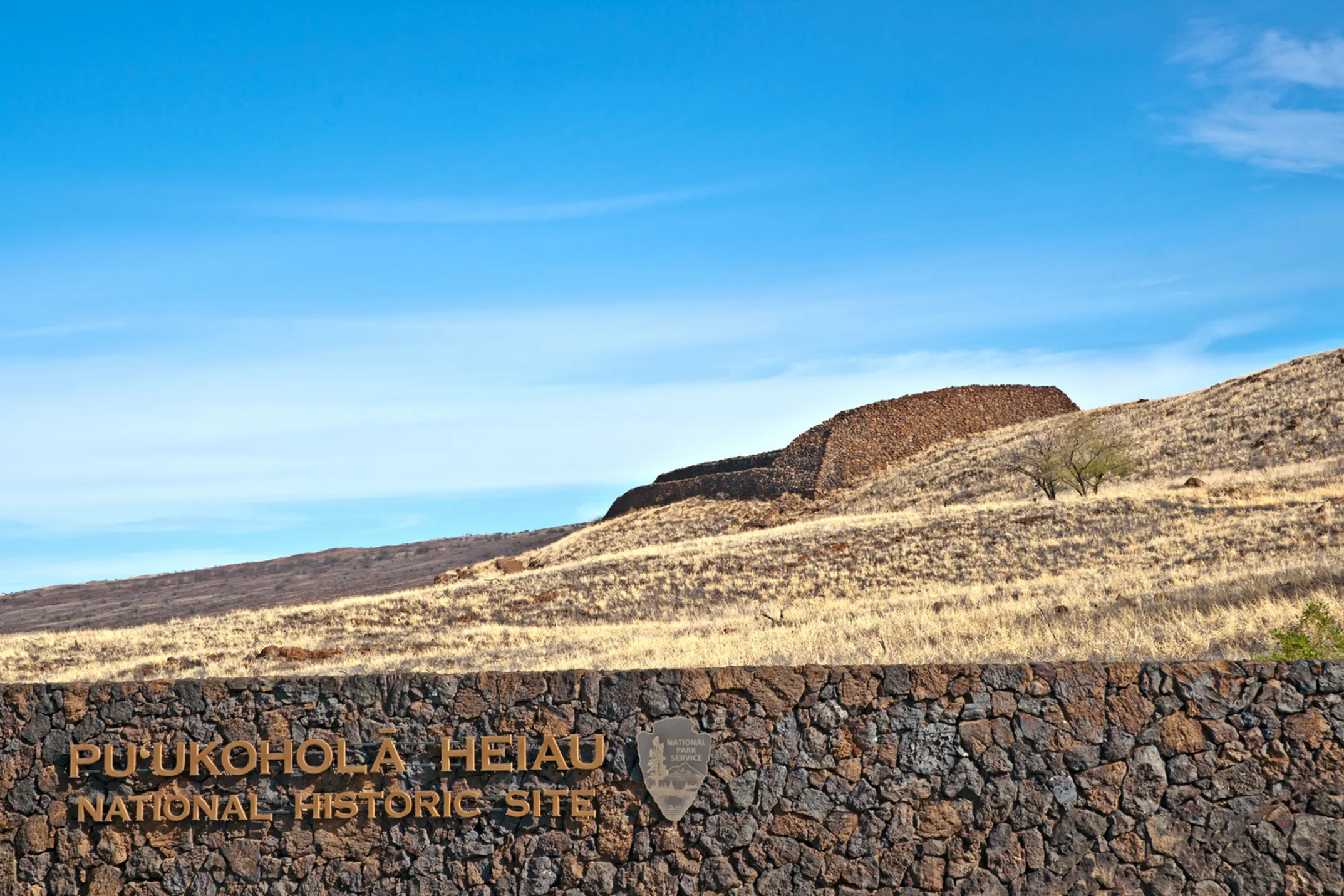
Dominating the landscape is Puʻukoholā itself, a luakini poʻokanaka, a state-level temple of the highest order that could only be commissioned by a paramount chief. When it was active, its stone platform would have been furnished with thatched structures. These included a house for the high priest, a house for sacred objects, a tall oracle tower (ʻanuʻu) wrapped in white kapa cloth for communicating with the gods, and fearsome wooden images (haku ʻōhiʻa) representing Kū. For a time, this was the political and religious capitol of the new kingdom. The place from which Kamehameha ruled and brought Hawaiʻi onto the world stage.
Mailekini Heiau: From Ancient Rites to Royal Fort
Just below the great heiau sits the older, more enigmatic Mailekini Heiau. Its original purpose is lost to time, though historians believe it was likely a war or agricultural temple from an earlier era of chiefdoms. Some traditions hold that it was here that Keōua's body was ritually prepared for his final journey up to Puʻukoholā's altar.
Mailekini's most fascinating chapter, however, is its transformation. It stands as a powerful symbol of the collision of two worlds. Around 1812, Kamehameha, influenced by his foreign advisor John Young, had as many as 21 European cannons mounted upon its ancient stone walls. An ancient place of worship became a modern fort. Its sacred stones repurposed to guard the harbor with the thunder of gunpowder. In this single structure, you can see the shift from the age of stone and spear to the age of cannon and sail.
Puʻukoholā Features
- • High priest's house
- • Sacred objects house
- • Oracle tower (ʻanuʻu)
- • Wooden god images (haku ʻōhiʻa)
- • Political & religious capitol
Mailekini Transformation
- • Original: Ancient temple
- • Ritual preparation site
- • 1812: Fortified with cannons
- • 21 European cannons mounted
- • Harbor defense system
Hale o Kapuni: The Sunken Realm of the Shark Gods
The oldest and most mysterious spiritual site here lies hidden beneath the waves. Just offshore, submerged in the bay, are the ruins of Hale o Kapuni, a temple dedicated to the powerful shark gods of Kawaihae. While harbor construction and silt have obscured it, local oral traditions vividly recall its existence. Elders remember when its stone walls were still visible at low tide. This was a place where the chiefs of the land and the chiefs of the ocean convened. A nexus of human and elemental power.
The worship of sharks as ʻaumākua—deified ancestors and family guardians—was a profound part of coastal life. Legends tell of the specific shark gods of this area, like the twin brothers Uukanipo, who were fed ritual offerings, and Kaaipai, who would help his human keepers by raiding food-laden canoes.
But Hale o Kapuni also has a darker side. An 1859 account by visitor Theophilus Davies describes how the bodies of human sacrifices from the temple on the hill (likely Mailekini) were brought down to a pile of stones in the ocean to be devoured by the sharks, the "supposed deities." This gruesome practice is linked to the Pōhaku o Alapaʻi, a leaning stone on the shore where a chief infamous for his love of using human flesh for shark bait would sit and watch the sharks feed in the sacred enclosure of Hale o Kapuni.
Even today, reef sharks patrol these waters, living reminders of the ancient, primal power this place holds.
The connection between land, sea, and spirit remains unbroken, a testament to the enduring mana of Puʻukoholā.