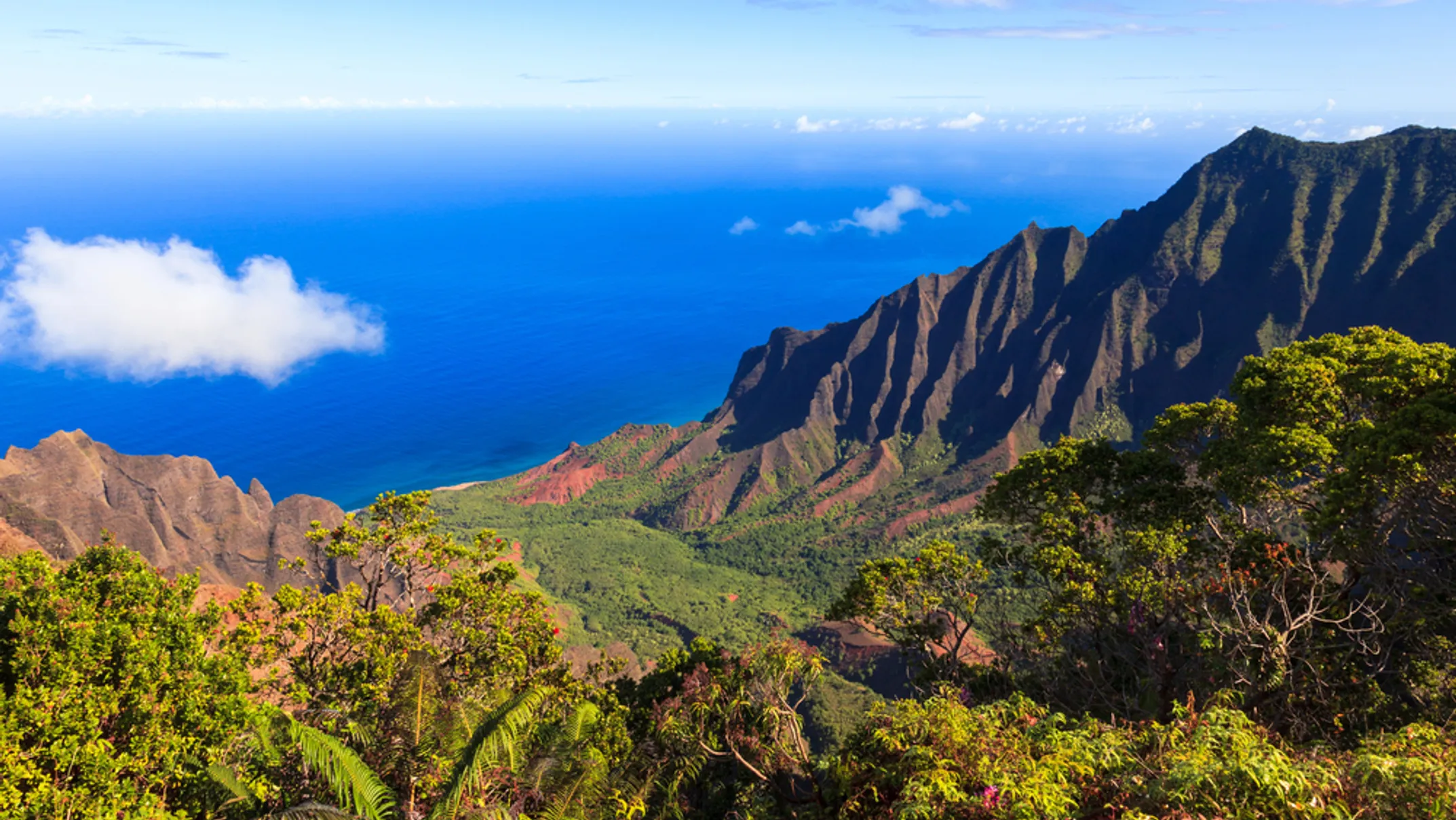

The drive up Kōkeʻe Road is a journey of ever-increasing anticipation. The road twists and turns, climbing higher and higher. It culminates in two of the most spectacular views in all of Hawaiʻi. While they both gaze into the same majestic valley, they offer very different experiences.
Kalalau Lookout (Mile Marker 18): The Classic Postcard
This is the view you've seen in pictures. Nothing can prepare you for the real thing. As you walk to the railing, the world simply falls away. Before you lies the Kalalau Valley—a breathtaking amphitheater of emerald-green cliffs. They're fluted and folded by millennia of wind and rain, plunging 4,000 feet to a distant, turquoise sea.
This is the first, jaw-dropping, head-on vista you get. It's easily accessible, making it the most popular stop for tour buses and casual visitors.
Practical Tip: The Restroom Stop
The Kalalau Lookout has restroom facilities. This is a crucial detail to remember. The next lookout, Puʻu O Kila, does not have any. Make this your planned pit stop.
What You're Seeing
As you gaze down, remember the history held within those cliffs. The Kalalau Valley was once home to thousands of Native Hawaiians. It was a self-sufficient community living in one of the most remote places on earth. Today, it's the heart of the Nāpali Coast State Wilderness Park. It's accessible only by sea or by completing the grueling 11-mile Kalalau Trail from the North Shore.
Puʻu O Kila Lookout (End of the Road): The Ultimate Panorama
Here's an Insider Tip
If you ask any local hiker or photographer, they'll tell you to keep driving. Just a mile past the Kalalau Lookout, at the very end of the road, is the Puʻu O Kila Lookout. While the first lookout is stunning, this one is superior in my opinion.
Being slightly higher (around 4,153 feet) and further along the rim, Puʻu O Kila offers a more angled, sweeping panoramic perspective. From here, your view isn't just into the valley. It extends further down the rugged Nāpali Coast, revealing more of the dramatic, knife-edge cliffs as they march toward the sea.
On a truly clear day, you can even catch glimpses of the white sands of the North Shore. This is the adventurer's choice—the view that rewards the extra effort. It's also the official starting point for the Pihea Trail, one of the park's signature hikes.
Current Access Information
Note: The gate providing car access to the Puʻu O Kila Lookout has been closed for road repairs since March 2024. You can still reach it by walking from the Kalalau Lookout parking area. It's about a mile walk along the road, but absolutely worth it for the superior views.
Pro-Tips for Both Lookouts
Timing is Everything
To give yourself the best chance of a clear view and to avoid the biggest crowds, you must arrive early. I aim to be at the lookouts before 9 AM. The clouds often roll in mid-morning and can linger for the rest of the day.
The Art of Patience (Beating the Fog)
The weather here is notoriously fickle. If you arrive and the entire valley is socked in with thick white fog, don't give up and leave immediately. I've sat at Puʻu O Kila for 20 minutes in a total white-out, ready to call it a day. Then the clouds parted like a theater curtain for the most spectacular, sun-drenched reveal. Kokeʻe rewards the patient.
Photography Tips
The best light for photography is in the early morning (7-9 AM) when the sun illuminates the valley walls. Late afternoon (4-6 PM) also offers dramatic lighting with long shadows across the cliffs.
- • Bring a wide-angle lens to capture the full panorama
- • Use a polarizing filter to enhance the greens and blues
- • Be prepared for rapidly changing conditions
- • Consider bringing a tripod for low-light conditions in fog
Safety Considerations
While the views are spectacular, remember these important safety tips:
- • Stay behind railings and barriers at all times
- • The edges are extremely dangerous—cliffs drop thousands of feet
- • Watch children closely
- • Be cautious in wet or windy conditions
- • Don't climb on rocks or barriers for photos
Understanding the Kalalau Valley
The valley you're looking into is one of the most significant places in Hawaiian history and culture. Understanding its story deepens the experience.
Historical Significance
For centuries, Native Hawaiian families lived in the Kalalau Valley, farming taro in terraced fields and fishing the abundant waters. At its peak, the valley supported hundreds of residents. The last permanent residents left in the 1920s, though the valley remains sacred to Native Hawaiians.
Geological Formation
The valley was carved over millions of years by the Kalalau Stream. The dramatic fluted cliffs are the result of constant erosion from wind and rain. The valley is part of the ancient Waimea Canyon volcanic caldera, formed over 5 million years ago.
Accessing the Valley Today
The only legal ways to reach the valley floor are by hiking the 11-mile Kalalau Trail from Hāʻena State Park (requires permit) or by kayak or boat from the ocean (weather permitting). Helicopter access is not permitted in the Nāpali Coast State Wilderness Park.
Conservation Efforts
The valley is part of a protected wilderness area. Efforts are ongoing to remove invasive species, protect native plants and birds, and preserve archaeological sites. Visitors help by staying on designated trails and following Leave No Trace principles.
What to Bring to the Lookouts
Essential Items
- • Camera or smartphone
- • Warm jacket or fleece
- • Rain jacket
- • Water bottle
- • Sunscreen
Optional but Helpful
- • Binoculars
- • Tripod for photos
- • Hat for sun/wind
- • Snacks
- • Portable chair
What NOT to Bring
- • Drones (prohibited)
- • Pets (not allowed)
- • Expectations of cell service
- • Flip-flops (wear real shoes)
Seasonal Considerations
Summer (April - October)
Generally better weather with clearer skies, though fog can still occur. Expect more visitors and tour buses.
- • Best chance for clear views
- • Warmer temperatures (60s-70s°F)
- • More crowded parking
- • Arrive extra early
Winter (November - March)
More frequent rain and fog, but also fewer crowds. When clear, the air is incredibly crisp.
- • More fog and rain
- • Cooler temperatures (50s-60s°F)
- • Fewer visitors
- • Bring extra layers
🌺 Respecting the Sacred
The Kalalau Valley is a sacred place in Hawaiian culture. When visiting the lookouts, please show respect:
- • Speak quietly and be mindful of others
- • Don't throw anything into the valley
- • Pack out all trash
- • Stay on designated paths
- • Be respectful in your photos and social media posts
Explore More of Kokeʻe
Discover the trails, lodge, camping, and wildlife
ℹ️ Lookout Info
- Kalalau Elevation: ~4,000 ft
- Puʻu O Kila: ~4,153 ft
- Distance Apart: ~1 mile
- Best Time: Before 9 AM
- Restrooms: Kalalau only
- Accessibility: Paved paths
🗺️ Kokeʻe Guide
🗺️ West Side Guide
⏰ Best Times to Visit
- Sunrise (6-7 AM): Fewest crowds, magical light
- Early Morning (7-9 AM): Best clarity, fewer people
- Late Afternoon (4-6 PM): Dramatic shadows, golden hour
- Avoid: 10 AM - 2 PM (crowds, clouds)
🌤️ Weather Tips
- Fog can roll in anytime
- Wait 15-20 min if foggy
- Bring layers (40s-70s°F)
- Rain jacket essential
- Wind can be strong