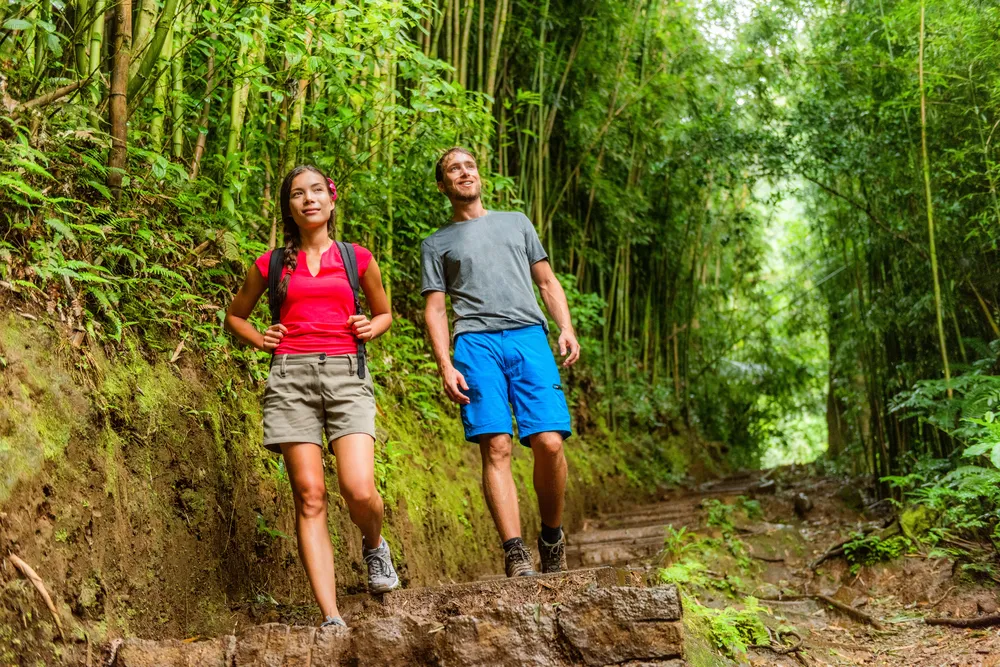
Heritage Trail Stops 5-14
From Sacred Hawaiian Temples to the Heart of Sugar Town
Written by a Local Heritage Expert
Kalani MillerStop 5: Kihahouna Heiau – An Ancient Place of Power
We now step back into the world of ancient Hawaiʻi at Kihahouna Heiau. This is a wahi pana, a sacred and storied place. This site once featured a large, walled temple, measuring approximately 130 feet by 90 feet, that served as a center for worship and ceremony.
According to oral traditions, the heiau was dedicated to four powerful deities: Kāne, one of the four primary Hawaiian gods; Hulukoki, a bird god; and two revered shark gods, Kū-hai-moana and Ka-moho-aliʻi. It was a place where Hawaiians connected with the divine forces that governed their world, likely offering prayers and tributes to ensure agricultural fertility and prosperity for the community.
The preserved stone platforms and walls of the heiau are still clearly visible, standing as a silent testament to the faith and engineering skill of ancient Hawaiians. The perimeter of the sacred site is marked by three distinctive hala-lihilihi-ula trees. This remains an active cultural site for Native Hawaiians.
My tip: Please remember that this is not a ruin or a tourist attraction; it is a sacred temple. Approach it with the utmost respect. Stay on the designated paths and never climb on, move, or take any of the stones. The best way to experience Kihahouna is to stand quietly, observe the masterful rockwork, and feel the deep mana (spiritual energy) that still resides in this powerful place. The three hala trees are your boundary markers.
Stop 6: Poʻipū Beach Park – Crossroads of History and Nature
While Poʻipū Beach is now world-renowned and has been named the best beach in America, its historical significance runs much deeper than its golden sands. This entire area was the shoreline of the great ancient Hawaiian settlement of Kāneiolauma. For centuries, this was a bustling center of coastal life.
Tragically, over a thousand archaeological features of this village were lost, first during land clearing for the Kōloa sugar plantation and later during the development of modern resorts and residences. This loss makes the preservation of the remaining sites, like the nearby Kāneiolauma Heiau complex, even more critical.
Poʻipū Beach Park is the jewel of the South Shore. It is famous for its twin crescent bays, separated by a narrow sandbar known as a tombola. The calm, protected waters make it ideal for swimming and snorkeling, and it is one of the most likely places on Kauaʻi to see endangered Hawaiian monk seals and honu resting on the sand. The park has full facilities, including lifeguards, restrooms, and picnic areas.
My tip: The calm, shallow pool on the left (eastern) side of the sandbar is perfect and safe for keiki (children). If you are lucky enough to see a Hawaiian monk seal on the beach, please show your aloha. Stay at least 50 feet away and never try to touch them or get between them and the water. They are critically endangered, and we are privileged to share this āina with them.
Stop 7: Keoneloa Bay (Shipwreck Beach) – The Long Sand
The proper Hawaiian name for this bay is Keoneloa, which means "the long sand". This is one of the most significant archaeological sites on Kauaʻi. Between 200 and 600 A.D., it served as a temporary fishing camp for the earliest Hawaiian settlers. Archaeologists have unearthed priceless artifacts here, including coral abraders and stone tools that give us a window into their daily lives.
This was a sacred fishing ground where heiau and ahu (altars) were built to honor the fishing god Kānaʻaukai. The more common name, "Shipwreck Beach," is much more recent, coming from the visible wreckage of a fishing boat that ran aground here in the 1970s.
A beautiful but often windswept and rugged beach, popular with experienced surfers, bodyboarders, and those who love to walk the shore. To your left as you face the ocean, you can see a reconstructed stone wall that marks the ancient boundary between the ahupuaʻa of Weliweli and Paʻa.
My tip: This beach is the official starting point for the magnificent Māhāʻulepū Heritage Trail, one of the last undeveloped stretches of coastline on the South Shore. Even if you don't plan to hike the entire trail, I highly recommend walking east along the cliffs for at least 15-20 minutes. The views are breathtaking, and you will be walking on the ancient, lithified sand dunes of our next stop.
Stop 8: Makawehi & Paʻa Sand Dunes – A Story in Stone
The dramatic cliffs rising from the eastern end of Keoneloa Bay are not made of volcanic rock, as one might assume. They are lithified sand dunes—ancient hills of sand that have hardened into stone over thousands of years. This sandstone dates back more than 125,000 years, to a time when sea levels were different.
The cliffs are also a rich fossil bed. Paleontologists have discovered the bones of now-extinct native birds here, including a large, flightless goose and a unique species of owl, giving us a glimpse into Kauaʻi's prehistoric ecosystem. The Hawaiian name for the point, Makawehi, translates to "calm face" or "beautiful face," perhaps referring to the striking appearance of the cliffs.
A unique and fragile geological landscape of layered sandstone, constantly being sculpted by the wind and waves. It's a fantastic spot for hiking, photography, and bird watching.
My tip: As you walk along the trail atop the cliffs, look down at the rock face. You can clearly see the different layers, or strata, of the ancient dunes, like looking at a cross-section of deep time. This is also one of the best and most accessible places on the South Shore for whale watching during the winter migration season (typically December through April).
Stop 9: Puʻuwanawana Volcanic Cone – The Birth of the Island
This stop zooms our perspective out from human history to the deep geological time that created Kauaʻi itself. The island was formed over 5 million years ago by a volcanic hotspot in the Earth's crust. The nearby Hāʻupu Ridge contains some of the island's oldest exposed geologic formations.
In contrast, Puʻuwanawana is a much younger volcanic feature known as a cinder cone—the simplest and smallest type of volcano, formed from ejected igneous rock. The connection to the trail's main story is crucial: it was the millions of years of weathering of this volcanic material that created the incredibly fertile soil of the Kōloa plains, the very soil that made the region perfect for the sugar plantations that would later define its history.
From the roadside marker, you can clearly see the distinct, symmetrical shape of the cinder cone rising from the plains. The circular ridge in the distance is the remnant of the cone's crater.
My tip: This stop beautifully connects the island's violent volcanic past to its rich agricultural history. You are literally looking at the source of the āina's fertility. The cone itself is on private land and cannot be hiked, but the view from the road gives you a perfect sense of its classic volcanic shape and its place in the landscape.
Stop 10: Hapa Road – The Path of History
Hapa Road is a physical timeline of the South Shore, a path that has been transformed by each successive era of Kōloa's history. Its story begins as an ancient Hawaiian footpath, part of a network that connected coastal and inland communities, with nearby lava rock walls dating back to 1200 A.D.
With the rise of the sugar industry in the late 1800s, the path was widened and became an industrial artery. Train tracks were laid along it to haul harvested sugarcane from the fields to the Kōloa mill for processing. It also served as the main purveyor's cart path connecting the port at Kōloa Landing with the shops and businesses in Kōloa Town.
During World War II, its strategic importance shifted again, serving as a critical supply and emergency evacuation route for the military.
The tracks are gone, and the road has returned to a quiet, unpaved path. It is now a favorite route for locals and visitors to walk or bike the scenic stretch between the resorts of Poʻipū and the historic charm of Old Kōloa Town.
My tip: I recommend starting from the Poʻipū end (near the traffic circle) and walking north towards Kōloa Town. It's a gentle, mostly flat, and slightly downhill walk of about two miles. As you walk, try to imagine the sounds of the path changing through time—from the soft tread of bare feet and the songs of native birds in ancient times, to the loud, rhythmic clatter of the cane trains, and now, back to a welcome peace and quiet.
Stop 11: Kōloa Jodo Mission – A Legacy of Faith
As the sugar industry boomed, it created an immense demand for labor that the local population could not fill. Plantation owners began recruiting workers from around the globe, including a large number of immigrants from Japan. These workers brought more than just their labor; they brought their culture, traditions, and faith.
The Kōloa Jodo Mission was founded in 1910 by Reverend Jitsujo Muroyama to serve this growing Japanese community. The Jodo Shu, or Pure Land School of Buddhism, taught that salvation was accessible to all people through faith and chanting, a message that resonated deeply with the hardworking laborers of the plantations.
A beautiful and active Buddhist temple, built in a traditional Japanese architectural style. It stands as a testament to the resilience of the immigrant cultures that helped build Hawaiʻi. The temple is surrounded by a peaceful meditation garden and houses a 12-foot statue of Amida Buddha.
My tip: This temple is a cherished part of our community. If you visit, please do so with respect, especially if a service is in session. The annual Bon Dance held here in the summer is a wonderful cultural event that is open to everyone. It's a joyous celebration of remembrance, with drumming, dancing, and food, and it's a great way to experience this living heritage firsthand.
Stop 12: The Sugar Monument – The Engine of Change
This monument stands at the epicenter of the revolution that redefined Hawaiʻi. It marks the site of the islands' first commercially successful sugar plantation, founded in 1835 by the American company Ladd & Company. The first mill, powered by a waterfall, was built nearby, but its wooden rollers quickly wore out. A new, more robust mill was built on this site in 1841, and its stone chimney still stands today.
In 1837, the plantation produced its first commercial export: over 4,000 pounds of sugar and 700 gallons of molasses. But this success came at a cost. The Native Hawaiian workers were paid just $2 a month in scrip, redeemable only at company stores. In 1841, these workers staged the first major labor strike in Hawaiian history, demanding their wages be doubled from 12.5 cents to 25 cents a day. Though unsuccessful, it was a courageous act of resistance that foreshadowed the labor struggles of the next century.
The centerpiece is a large, circular concrete sculpture, designed to look like a millstone. It holds a powerful bronze sculpture by Jan Gordon Fisher depicting the eight principal ethnic groups that built the sugar industry: Hawaiian, Caucasian, Puerto Rican, Chinese, Korean, Japanese, Portuguese, and Filipino. The sculpture opens up to face the tall, stone smokestack of the 1841 mill, the most iconic remnant of the original plantation.
My tip: This spot represents the birth of modern, multicultural Hawaiʻi, a process that was both beautiful and profoundly difficult. Take a moment to look at the diverse faces on the bronze sculpture. Then, turn and look at the old stone chimney. Imagine the intense heat, the deafening noise of the machinery, and the grueling, back-breaking labor that took place here. The monument celebrates the unity that was forged, but it's important to also remember the hardship and struggle that made that unity necessary.
Stop 13: Yamamoto Store & Kōloa Hotel – The Heart of Town
As the plantation grew, a town grew around it. This corner was the commercial and social heart of that town. The Yamamoto Store, first built in 1898, was once the oldest commercial building in Kōloa. It was a classic plantation general store, selling everything from groceries and liquor to, starting in 1915, gasoline from a single pump out front.
The adjacent Kōloa Hotel was constructed around the turn of the century, likely as an extension of the store. It wasn't a tourist hotel but a lodging house for the many traveling salesmen, known as "drummers," who traveled from Oʻahu to sell their wares to the various plantation stores across the island. It was a bustling hub of commerce and community gossip.
The historic buildings have been beautifully preserved and now house modern businesses, giving you a "then and now" experience. The original Yamamoto Store building is home to the popular retailer Crazy Shirts, while the former Kōloa Hotel now houses the South Shore Pharmacy.
My tip: Stand across the street and just look at the architecture. You can still clearly see the classic clapboard storefronts and covered walkways of the plantation era. Imagine this corner bustling with workers cashing their pay, salesmen showing their samples, and families buying their weekly supplies. This was the center of their world.
Stop 14: Kōloa Missionary Church – A New Foundation
The arrival of American commerce and American Christianity happened in parallel. The Kōloa mission station was established in 1834 by Reverend Peter Gulick, and the congregation was officially organized in April 1835—the very same year that Ladd & Company founded the sugar plantation. The first chapel, a simple thatched building, was constructed in 1837.
After a powerful storm destroyed that structure in 1858, the community rallied to build the permanent church you see today. Made of local stone and coral blocks harvested from the reef, the new church stood on high ground and was so prominent that its steeple served as a landmark for ships approaching the coast. The mission was also home to dedicated medical missionaries, like Dr. James Smith, who provided essential healthcare to the Hawaiian community for decades.
The Kōloa Missionary Church, now known as The Church at Koloa, is the first Congregational church established on Kauaʻi and remains an active place of worship. Its beautiful, sturdy construction is a testament to the faith and determination of its founders.
My tip: The church and the sugar mill were the twin pillars of the new society being built in Kōloa. Notice the texture of the walls. The use of coral blocks, painstakingly cut from the reef and hauled up the hill, is a powerful physical representation of how the missionaries used the materials of the āina to build their new foundations of faith on the island.
You've now completed all 14 stops of the Kōloa Heritage Trail. But the journey doesn't end here. Continue exploring to discover practical visitor information, the deeper historical connections, and the cultural renaissance that continues to shape Kauaʻi today.
Continue Your Heritage Trail Journey
Discover practical tips, deeper historical context, and the living cultural legacy of Kōloa.
📍 Stops 5-14
- Kihahouna Heiau
- Poʻipū Beach Park
- Keoneloa Bay
- Makawehi Sand Dunes
- Volcanic Cone
- Hapa Road
- Jodo Mission
- Sugar Monument
- Yamamoto Store
- Missionary Church
🙏 Respect Sacred Sites
- Never climb on heiau stones
- Stay on designated paths
- Don't move or take stones
- Keep 50 ft from monk seals