History & Legacy
The Wilcox Era and the Iconic Green Church of Hanalei

Written by a Local Cultural Historian
Kalani MillerTo walk through the Mission House today is to step into a perfectly preserved time capsule. The home was meticulously restored in 1921 by the granddaughters of missionaries who succeeded the Alexanders, and it feels as though its 19th-century occupants just stepped out for a moment.
The parlor showcases the family's attempt to recreate respectable American domesticity in this remote valley. Fine furniture made from native koa wood fills the room, including an elegant settee and a striking 12-sided table with rosewood veneer. Two melodeons—small reed organs popular at the time—speak to the central role music played in missionary life and worship.
One melodeon was a gift to George Wilcox, one of the sons who grew up in the house. The other tells a story of missionary ingenuity. Found in termite-ridden pieces during the 1921 restoration, the salvaged rosewood was shipped to San Francisco and remade into the small, elegant desk that now stands in the parlor.
The study reveals the intellectual heart of the mission. A koa bookcase holds part of the family's library, which numbered over 200 titles—an extraordinary collection for such an isolated outpost. This library powered their work of teaching, translation, and spiritual guidance. Among the books sits Abner Wilcox's personal Bible, published around 1806, its worn pages testament to decades of daily use.
Throughout the house, personal artifacts bring the missionary experience to life. Lucy Wilcox's sewing basket sits ready for use. A heavy, coal-heated iron speaks to the endless domestic labor required of missionary wives. A pewter whale oil lamp hints at long nights spent reading and writing by flickering flame. The original trunk that carried the family's possessions on their perilous sea journey around Cape Horn sits as silent witness to their commitment and sacrifice.
The Wilcox Era: Education and Growth
In 1846, the Alexanders relocated to Maui seeking a drier climate for their health. The mission passed to Reverend Abner and Lucy Wilcox, dedicated educators from Connecticut who would spend over two decades at Waiʻoli. They raised seven sons in the Mission House and transformed the mission school into a pioneering institution for vocational training.
The Wilcoxes expanded the mission's impact far beyond religious instruction. They taught practical skills like farming, carpentry, and mechanics alongside reading, writing, and Christian doctrine. Their approach recognized that Hawaiians needed tools to navigate the rapidly changing world around them.
Abner Wilcox became deeply involved in local governance and land management. He served as a circuit judge and helped Hawaiian families navigate the complex legal requirements of the Great Māhele land division of 1848. His detailed journals provide invaluable insights into daily life in 19th-century Hanalei and the challenges faced by both missionaries and Hawaiians during this period of dramatic change.
Lucy Wilcox focused on education and women's work. She taught Hawaiian women new domestic skills while learning traditional practices herself. Her letters home describe the delicate balance of trying to "civilize" Hawaiian customs while respecting the intelligence and dignity of the people she served.
The Wilcox sons grew up as true children of two worlds. They spoke fluent Hawaiian and English, understood both Christian and traditional Hawaiian values, and developed deep connections to the land and people of Hanalei. Several would go on to become prominent figures in Hawaiian business and politics, embodying the complex legacy of the missionary era.
After Abner and Lucy Wilcox died in 1869, the Mission House sat vacant for over fifty years. It might have crumbled into ruin if not for three of their granddaughters—Elsie, Mabel, and Lucy Etta Wilcox. In 1921, they purchased the property and funded its careful restoration by architect Hart Wood, preserving it as the museum we can visit today.
The Green Church: Icon of Faith and Community
While the Mission House tells the story of daily life, the church buildings reveal the spiritual heart of the Waiʻoli Mission. The first structures were fragile pole-and-thatch meetinghouses that couldn't withstand Hanalei's powerful storms and occasional fires. This led the congregation to build something more permanent.
Completed in 1841, the new church was a testament to both durability and resourcefulness. It featured a timber frame with plaster walls made from lime created by burning coral harvested from the reef at low tide. The building required constant maintenance in Hanalei's wet climate, but it served the community faithfully for over seventy years.
In 1843, the mission acquired its historic bell, which was hung in a freestanding belfry behind the church. The bell's ring called the faithful to worship across the valley, its bronze voice carrying over taro fields and up mountain slopes. That same bell still rings today, an unbroken link to the mission's earliest days.
By the early 20th century, the descendants of the first missionaries had become some of the most prominent and wealthy figures in the Hawaiian Islands. In 1912, three of Abner and Lucy Wilcox's sons—Samuel, George, and Albert—funded construction of a new, grander church as a gift to the community and tribute to their parents' legacy.
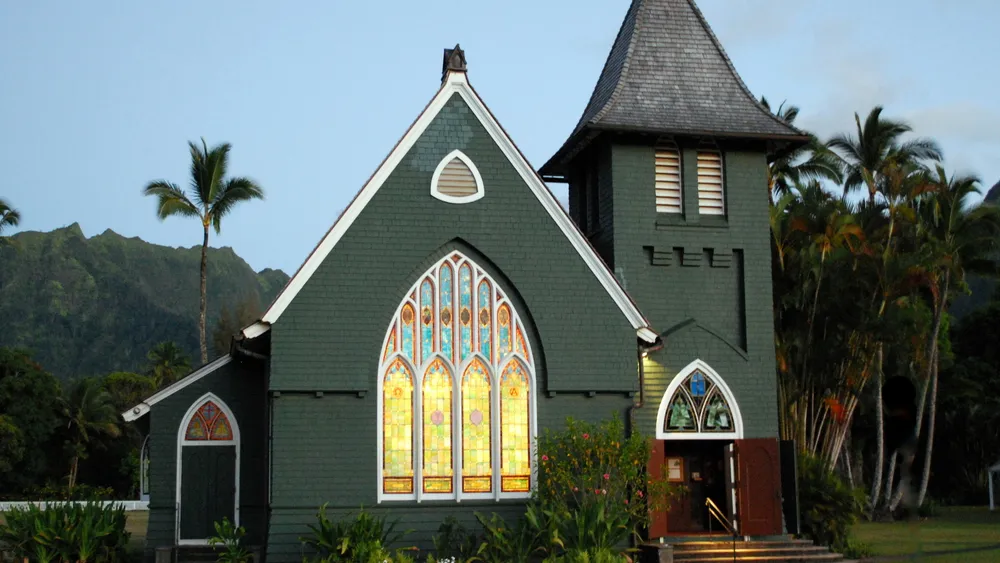
This new church is the iconic green-shingled building that has become synonymous with Hanalei. Designed in classic American Gothic style, its steep gabled roof, pointed-arch windows, and spired belfry create a sense of grace and reverence that seems perfectly suited to its dramatic mountain backdrop.
The church's stained-glass windows drew particular praise when the building was dedicated. A reporter for The Garden Island newspaper described them as "works of art upon which the eyes ever delight to feast," noting how they filled the sanctuary with light that reflected "all the colors of the rainbow intensified." These windows, combined with gracefully curving pews, create an interior space of serene and colorful beauty.
The new belfry became home to the original 1843 mission bell, linking the modern structure directly to the mission's earliest days. The bell still rings before every service, its voice carrying the same message of faith that has echoed through this valley for nearly two centuries.
Continue the Journey
Explore more of the Waiʻoli Mission story
ℹ️ Quick Info
- Location: Hanalei, Kauaʻi
- Built: 1837 (House)
- Church Built: 1912
- Tours: Tue, Thu, Sat
- Cost: By donation
- Phone: (808) 826-1528
👥 Key Figures
- William & Mary Alexander
- Abner & Lucy Wilcox
- Queen Deborah Kapule
- Gov. Kaikioʻewa
📅 Timeline
- 1834 - Mission established
- 1837 - House completed
- 1841 - Church built
- 1912 - Green church built