ʻOpaekaʻa Falls: Kauai's Most Sacred Valley
Where ancient legends flow with cascading waters in the heart of the royal Wailua Valley

Written by a Local Historian
Kalani MillerAloha Mai - A Welcome to the Valley of Kings
Aloha and welcome. My name is Kalani Miller, and I've been lucky enough to call these islands home my entire life. I remember my tūtū taking me to this lookout when I was just a small keiki. She had a way of seeing the world that I've carried with me always. She'd point to the waterfall and say, "That's for your eyes, kuʻu keiki." The water, the mist, the sheer beauty of it all—it was a feast for the senses. But then, she'd gently turn me around to face the vast, green valley stretching out below. "And this," she'd whisper, with a reverence that hushed the very air around us, "this is for your soul."
Those early morning visits with my tūtū shaped how I see this place today. We'd arrive just as the first light was painting the valley in soft golds and greens. The tourist buses hadn't started their rounds yet, and the only sounds were the distant crash of the waterfall and the gentle rustle of ironwood trees in the trade winds. She'd pack a thermos of strong coffee and some malasadas from the bakery in Kapaʻa, and we'd sit on the stone wall, watching the mist rise from the valley floor like the breath of sleeping ancestors.
My tūtū taught me that ʻOpaekaʻa isn't just a place you see. It's a place you feel. It's a portal that connects you to the aliʻi nui, the great kings and queens who once ruled this sacred land of Wailua. It's a place where stories are etched into the stones and carried on the wind.
Growing up, I took this place for granted the way kids do with the extraordinary things in their backyard. It wasn't until I left Kauaʻi for college on the mainland that I truly understood what a treasure we have here. When I'd try to describe ʻOpaekaʻa to my roommates at university, I'd find myself searching for words that didn't exist in English. How do you explain the feeling of standing in a place where the veil between past and present is so thin you can almost hear the chants of ancient ceremonies carried on the wind?
Most visitors come, snap a photo of the famous falls, and are on their way in minutes. They see the beauty, but they miss the soul. That's why I've created this story. I want to take you beyond the postcard view. Together, we'll explore the two distinct lookouts—the one for the eyes and the one for the soul. We'll uncover the deep moʻolelo behind the name ʻOpaekaʻa, tales of rolling shrimp and the powerful lizard guardians who protect these waters. We will walk, in spirit, through the sacred history of this royal valley, the center of power for all of Kauaʻi. And, most importantly, I will share the critical safety information every visitor must know to visit this place with the respect and care it deserves.
This is more than a waterfall. It's a history lesson, a cultural touchstone, and an experience that, if you let it, will stay with you long after you've returned home. My tūtū always said that the land remembers everything. Every footstep, every prayer, every tear of joy and sorrow. When you stand at ʻOpaekaʻa, you're not just observing nature. You're participating in a conversation that has been going on for over a thousand years.
ℹ️ Quick Info
- Location: Wailua, Kauaʻi
- Waterfall Height: 151 feet
- Park Hours: 7am-7:45pm
- Cost: Free
- Accessibility: Excellent
🗺️ Complete Guide
You are here
Important info & directions
Explore the East SideBeyond the falls
📅 Best Time to Visit
- Early morning (before 9am)
- After rain for full cascade
- Late morning for sparkling water
- Avoid tour bus hours (10am-2pm)
🎒 What to Bring
- Camera or smartphone
- Sunscreen & hat
- Water bottle
- Respectful attitude
The Two Faces of the Lookout - A Tale of Two Views
The ʻOpaekaʻa Falls lookout is unique because it offers two completely different, yet equally profound, experiences. They are separated by a simple crosswalk, but they represent two different ways of seeing Kauaʻi: one is the immediate, breathtaking spectacle of nature's power, and the other is a deep, panoramic view into the heart of Hawaiian history and culture.
The Main Event - The ʻOpaekaʻa Falls Vista
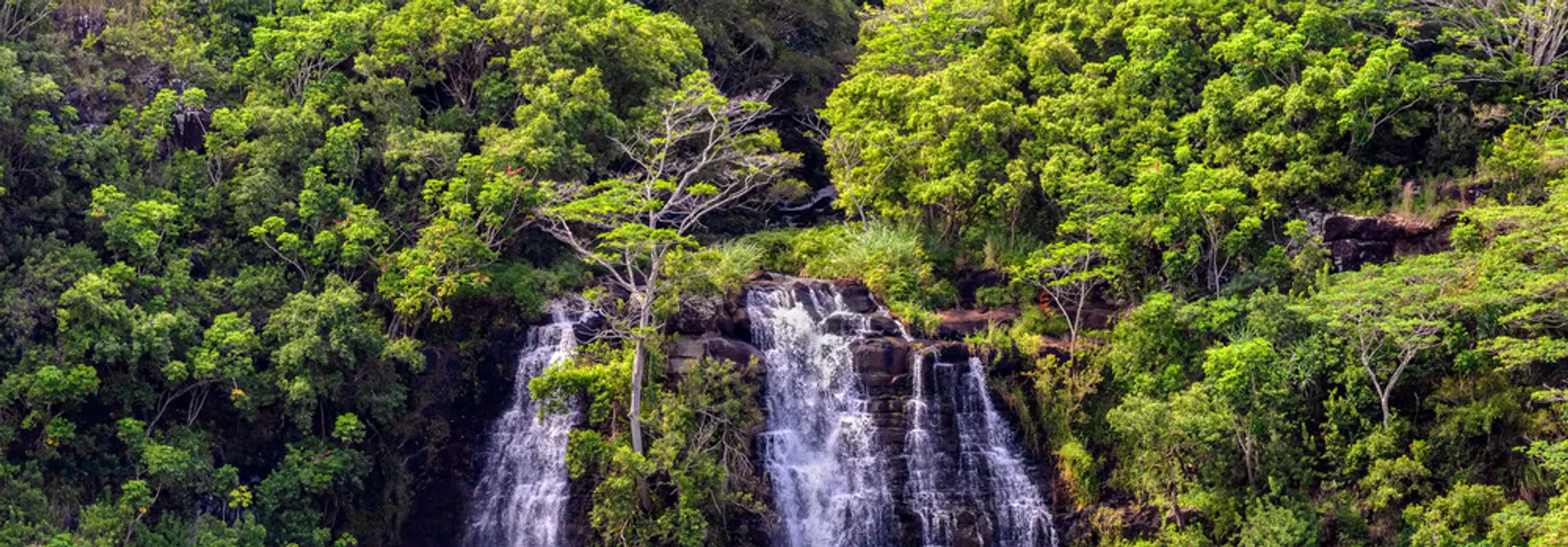
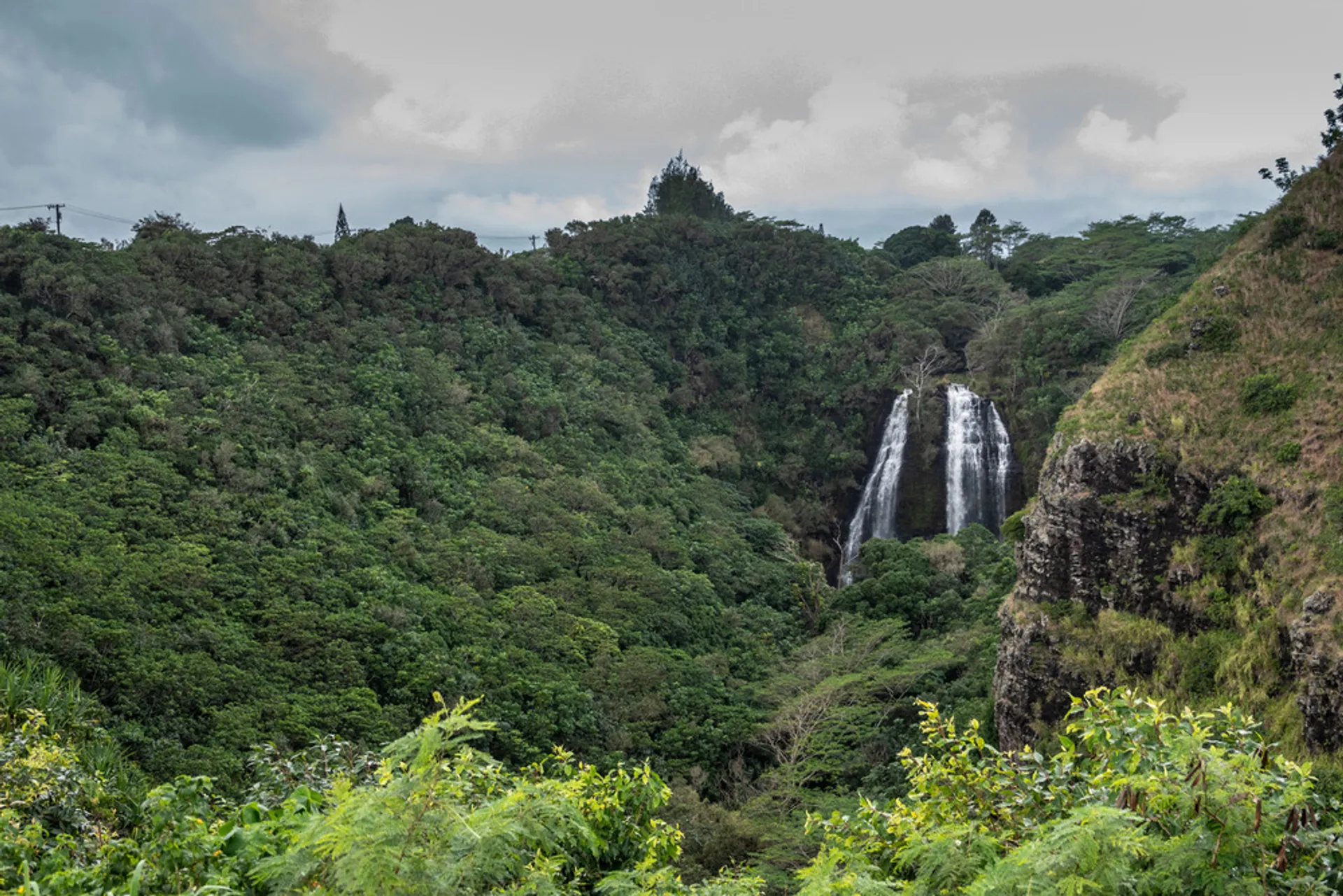
When you first arrive, your eyes are immediately drawn to the main attraction: ʻOpaekaʻa Falls. Cascading a dramatic 151 feet down a sheer cliff of dark, volcanic basalt, the waterfall is a stunning display of nature's artistry. It's about 40 feet wide and flows year-round, so you're always guaranteed a beautiful sight. After a good rain, what is often a delicate double cascade merges into a single, powerful torrent, thundering into a hidden pool below. The lush, green foliage that clings to the cliff face provides a vibrant contrast against the white veil of water, creating a picture-perfect scene.
The geology of this waterfall tells its own fascinating story. The basalt cliff that ʻOpaekaʻa tumbles over was formed millions of years ago when Kauaʻi was still a young, active volcano. The rock layers you see exposed in the cliff face are like pages in an ancient book, each one recording a different volcanic event in the island's formation. The deep grooves and channels carved into the rock by centuries of flowing water create natural sculptures that change with every season and every storm.
What many visitors don't realize is that the volume and character of the falls changes dramatically throughout the year. During the dry summer months, the waterfall maintains a graceful, almost ethereal quality, with two distinct streams creating a delicate bridal veil effect. But during the winter rainy season, particularly after the heavy rains that sweep across Mount Waiʻaleʻale, the falls transform into a thunderous cascade that you can hear from the parking lot. The mist generated by this powerful flow can reach the lookout platform, cooling visitors and creating perfect conditions for rainbows in the afternoon light.
Photography Tips
For photographers, this spot is a gift, but timing and technique are everything. I always tell first-time visitors they have a choice to make. If you want that iconic, sparkling shot, come in the late morning. When the sun is high, it hits the water directly, making it glitter like a thousand scattered diamonds. However, if you're like me and you prefer a softer, more mystical atmosphere, the early morning light is your friend. The light is more diffused, and you might even be blessed with a rainbow forming in the mist near the base—a truly magical experience.
Because the lookout is set back a good distance from the falls, a telephoto or zoom lens will be your best tool to truly capture the texture and detail of the water against the rock. Don't be discouraged by an overcast day, either. In fact, for long-exposure photography, cloudy skies are ideal.
The Hidden Gem - The Wailua River Lookout (The View You Can't Miss)
Most visitors take their photos of the falls and leave, thinking they've seen all there is to see. Please, don't make that mistake. The real story, the soul of this place, begins when you carefully cross the street. This second lookout offers a sweeping panorama that is, in many ways, even more significant than the waterfall itself.
From here, you are gazing down into the heart of the Wailua River Valley. Your eyes will follow the path of the Wailua River, Hawaiʻi's only navigable river, as it snakes its way from the island's interior towards the sea. This river was the lifeblood of ancient Kauaʻi, a sacred highway connecting the mountains to the ocean. The river system that you see before you supported thousands of people for centuries, providing not just transportation but also fresh water, fish, and the rich alluvial soil that made agriculture possible in the valley.
Look down and to your right, nestled on the riverbank, and you can see the thatched roofs of Kamokila Hawaiian Village. This is an authentic recreation of a traditional settlement, built on a historic village site that was once home to Kauaʻi's last king, Kaumualiʻi. Seeing it from above gives you a sense of how our ancestors lived in harmony with the river. The village represents not just a tourist attraction but a living classroom where traditional Hawaiian practices are preserved and shared.
This valley is so evocative of a lost world that it has served as a backdrop for major Hollywood films, including the opening scenes of Raiders of the Lost Ark and parts of Jurassic Park and Outbreak. When film scouts first saw this valley, they recognized immediately that it possessed a timeless quality that could transport viewers to other worlds and other times.
In the distance, you can also see the iconic profile of Nounou Mountain, more famously known as the "Sleeping Giant," watching over the valley as it has for millennia. This distinctive ridgeline has been a landmark for navigation and storytelling for generations of Hawaiians. According to legend, the mountain is actually a benevolent giant who fell asleep while protecting the people of the valley.
The physical separation of these two viewpoints—having to cross the road—is a perfect metaphor. The waterfall is the immediate, easily consumed beauty. The valley view requires a conscious act, a step across the pavement, to engage with something deeper: the culture, the history, the soul of Kauaʻi. It's the difference between seeing a pretty picture and beginning to understand the story behind it.
The Moʻolelo - Voices of the Sacred Valley
To truly appreciate this place, you have to listen to its stories. The Wailua Valley is not just a landscape. It is a library of moʻolelo—the legends, histories, and traditions passed down through generations. These stories give life to the rocks, the water, and the wind, connecting us to the deep past.
ʻOpaekaʻa - The Legend of the Rolling Shrimp and the Lizard Guardians
The name ʻOpaekaʻa is often the first story visitors learn. It literally translates to "rolling shrimp," from the Hawaiian words ʻopae (shrimp) and kaʻa (to roll or tumble). This name comes from a time when the native freshwater shrimp, a species called ʻopae kalaʻole, were so plentiful in the ʻŌpaekaʻa Stream that they could be seen tumbling over the falls in the rushing cascade.
But this simple, charming name hints at a much deeper ecological and spiritual truth. The abundance of these shrimp was not an accident. It was a sign of a healthy, balanced ecosystem, one that was protected. According to the old stories, this part of the river was watched over by powerful moʻo, ancient and formidable spirit guardians of our freshwater sources. These are not simple lizards. They are shape-shifting deities, often appearing as giant reptiles or dragons, who ensure the purity and vitality of the water.
🦎 Kamokila - The Female Guardian
Kamokila was said to be a female moʻo of enormous size and power, whose primary domain was the section of river directly below the falls. She was known for her fierce protection of the native species that lived in these waters. Fishermen would leave offerings of kalo and other foods at the water's edge before fishing, asking permission from Kamokila to take only what they needed for their families.
🐉 Kawelowai - The Male Guardian
Kawelowai, the second guardian, was described as a massive male moʻo whose territory extended from the falls upstream toward the interior mountains. His role was to control the flow of water during storms and droughts, ensuring that the communities downstream always had enough fresh water for their needs.
These moʻo were not just mythical creatures in the minds of the ancient Hawaiians. They represented a sophisticated understanding of watershed management and ecological balance that modern science is only beginning to appreciate. The presence of abundant ʻopae kalaʻole in the stream was indeed an indicator of excellent water quality, just as the stories suggested. These native shrimp are extremely sensitive to pollution and environmental changes, so their thriving populations signaled that the entire ecosystem was healthy.
Tragically, the ʻopae kalaʻole populations have declined dramatically in recent decades due to habitat loss, water diversions, and the introduction of non-native species. While you might still spot a few of these native shrimp in the quieter pools of the stream, the great rolling cascades that gave the falls their name are now mostly a memory preserved in stories. This ecological change represents not just an environmental loss, but a spiritual one as well, as the visible sign of the moʻo's guardianship has diminished along with the creatures they protected.
So, when you hear the name ʻOpaekaʻa, don't just picture shrimp. Picture a thriving, sacred ecosystem under the watchful eyes of its ancient protectors. Think about the complex relationships between spiritual beliefs, environmental stewardship, and cultural practices that sustained this place for centuries.
Wailua, the Valley of Kings - A Royal Center of Power
The story of the guardians leads us to the greater story of the valley itself. The Wailua River Valley was not just any valley. It was the political and religious epicenter of ancient Kauaʻi, one of the two most sacred and powerful centers on the island. This was the chosen home of the aliʻi nui, the paramount chiefs who held dominion over the island. Great rulers, including King Kaumualiʻi, the last independent king of Kauaʻi, held their court here.
The entire area is recognized as the Wailua Complex of Heiaus, a National Historic Landmark. This is not a single site but a system of at least seven major heiau (temples or places of worship) and other sacred sites, strategically and spiritually aligned along the King's Highway, an ancient trail that followed the river from the ocean at Wailua Bay all the way to the summit of Mount Waiʻaleʻale.
From the lookout, the most significant of these that you can see is Poliʻahu Heiau. Just before you reach the ʻOpaekaʻa Falls parking area, on the prominent bluff to your left as you drive up Kuamoʻo Road, you can see its ancient stone walls overlooking the river. Poliʻahu was no ordinary temple. It was a luakini heiau, one of the most important and powerful types of temples in ancient Hawaiʻi. These were state temples, dedicated to the war god Kū, where the most significant rituals were performed to ensure the success of the kingdom.
Like many great and ancient structures on Kauaʻi, legend attributes the construction of Poliʻahu Heiau to the Menehune. These were a legendary race of small, industrious people, said to be master builders who could complete enormous projects, like building a massive heiau, in a single night. While modern archaeology has revealed that these structures were actually built by ordinary Hawaiians over extended periods, the Menehune legends reflect the awe that later generations felt when confronted with the skill and ambition of their ancestors.
Near the heiau is another fascinating feature: the Bellstone. This was not just a random rock. It was a specific reddish basalt boulder that, when struck with other stones, would produce a distinct, low-frequency, ringing sound that could be heard for more than a mile down the valley. It was an ancient communication device, used to announce momentous occasions like the birth of a royal child or the approach of a sacred procession.
Standing at this lookout, you are truly at the heart of Kauaʻi's ancient royal capital. The view before you encompasses not just a beautiful landscape, but the spiritual and political center of an entire civilization. Every ridge, every bend in the river, every grove of trees has its own stories and significance in the complex tapestry of Hawaiian history and culture.
Ready to Explore Kauaʻi's Sacred Valley?
Learn essential safety information, get directions, and discover more adventures on Kauaʻi's beautiful East Side.