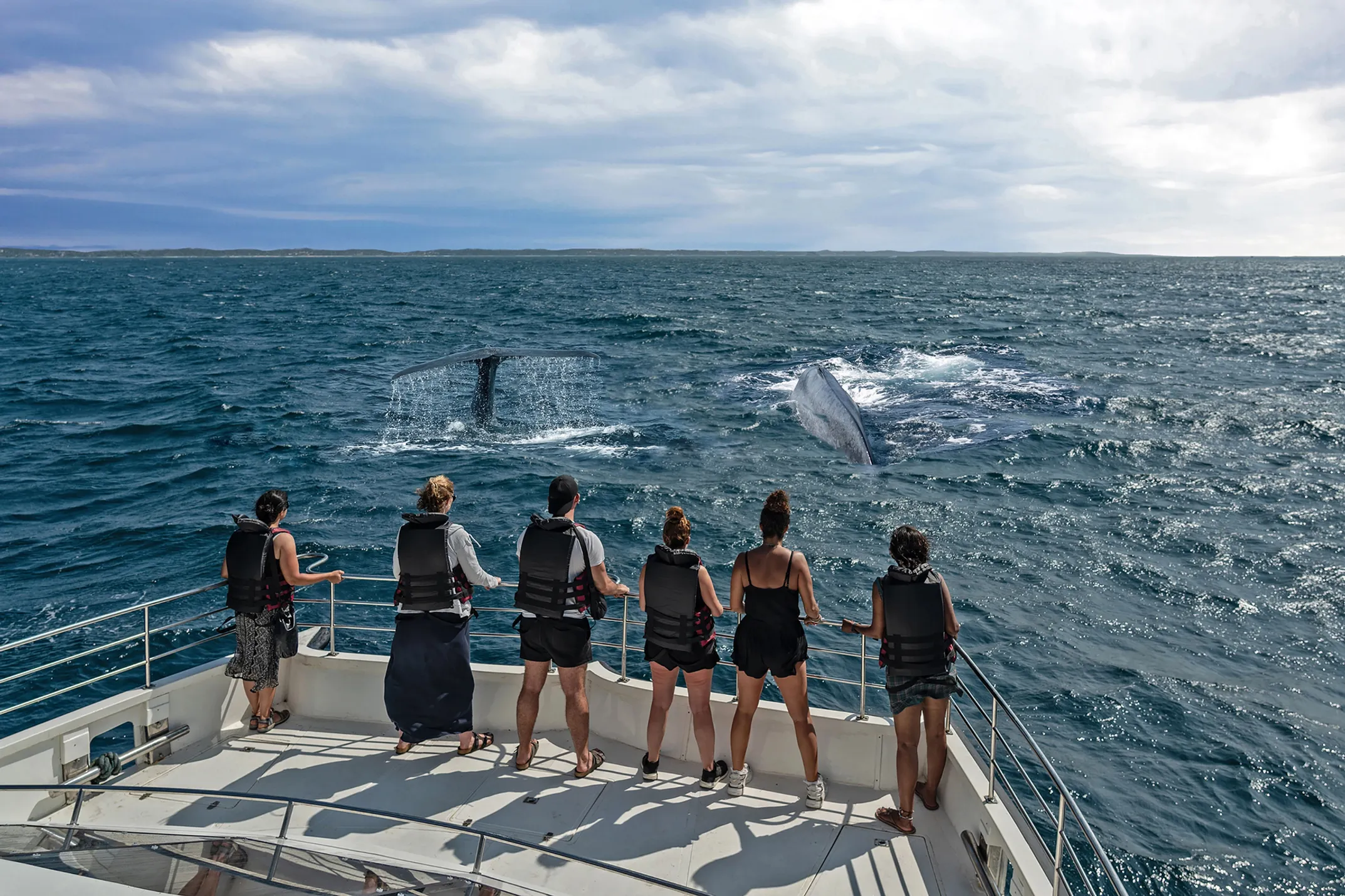
Big Island Whale Watching: Secrets to Witnessing Giants
Experience one of nature's most awe-inspiring events as thousands of humpback whales journey to Hawaiian waters

Written by a Local Expert
Kalani MillerI'll never forget the first time I dropped a hydrophone into the water off the Kona coast on a perfectly still February morning. The world above the surface was silent, just the gentle lap of waves against the hull. But below? Below was a symphony. The haunting, complex song of a male humpback vibrated through the boat, through my feet, and into my soul. It wasn't just sound; it was a story, an ancient language echoing across millennia. In that moment, I understood that we weren't just 'watching' whales; we were being invited into their world. It's that feeling, that profound connection, that I want to help you find.
Every winter, one of nature's most awe-inspiring events unfolds in our waters. Thousands of North Pacific Humpback Whales, known in Hawaiian as koholā, complete an epic 3,000-mile journey from their icy feeding grounds in Alaska to the warm, welcoming embrace of Hawaiʻi. This incredible migration, which can take six to eight weeks, is one of the longest undertaken by any mammal on Earth.
This article is the culmination of my life's work on these waters. We'll go beyond the basics. We'll explore the 'why' behind their incredible behaviors, I'll share my secret spots for watching from shore, and we'll navigate the different tour options so you can choose the perfect experience for you and your ʻohana. This is everything you need to know about Big Island whale watching, all in one place.

The Journey of Giants: Why Humpbacks Choose Hawaiʻi
People always ask me, "Why here? What's so special about Hawaiʻi?" The answer is simple and profound: our islands are the perfect nursery. It's not a vacation for the whales; it's a vital chapter in the survival of their species.
The journey itself is a monumental feat of endurance. The roughly 10,000 whales that make the trip do so while fasting, relying entirely on the thick stores of blubber they built up during the summer feeding frenzy in the nutrient-rich North Pacific. This period, known as "migration fasting," allows them to dedicate all their energy to the long swim and the critical tasks of reproduction and nursing once they arrive.
Their choice of Hawaiʻi as a destination is a brilliant evolutionary strategy, driven by three critical survival advantages that our waters provide.
Warm Cradle for Calves
Newborn humpbacks are born with very little insulating blubber, which would make the frigid waters of Alaska instantly lethal. Our warm, shallow waters, which hover around a balmy 75°F, are essential for their survival.
Safe Haven from Predators
The primary predator of a young humpback calf is the orca, or killer whale. For reasons that benefit the humpbacks immensely, orcas are not commonly found in Hawaiian waters.
Ideal Mating Arena
The season in Hawaiʻi is a vibrant, complex social gathering. It's here that males compete for the attention of females, putting on spectacular shows of power and singing their famously complex songs.
The cultural and ecological significance of this annual migration is so profound that in 1997, the waters around the main Hawaiian Islands were designated as the Hawaiian Islands Humpback Whale National Marine Sanctuary. This federal and state protection was established to safeguard these magnificent animals and the habitat that is so critical to their survival.
Decoding Whale Behavior: Reading the Ocean's Language
Out on the water, every splash tells a story. It's a language of power, grace, and intention. After years of observation, you start to see the patterns. It's not random splashing; it's communication. Let me teach you how to listen with your eyes. Understanding these behaviors will transform your experience from simple sightseeing into a true appreciation of their complex social lives.
The Breach: A Full-Body Proclamation
What it is: This is the one everyone dreams of seeing. A breach is when a whale propels its massive body—up to 40 tons—out of the water, crashing down with a thunderous splash. A "full breach" is when more than half the body clears the water, while other variations include a "half breach" or a "chin-slap breach," where the whale lands on its back or throat.
The 'Why': This spectacular display is not just for show; it serves several purposes. One of the primary reasons is communication. The incredible sound created by the impact can travel for miles underwater, acting as a long-distance signal to other whales, especially useful when wind and waves make underwater vocalizations difficult to hear. It can also be a show of strength during the breeding season, as males demonstrate their fitness and power to attract females or intimidate rivals. On a more practical level, the violent impact with the water is an effective way to dislodge skin parasites like barnacles and whale lice. And sometimes, especially with younger whales, it might just be a form of play or a way to get a better look at their surroundings.
Tail Slap (Lobtailing): An Emphatic Statement
What it is: A powerful and dramatic behavior where a whale lifts its massive tail flukes out of the water and forcefully slaps them down on the surface, creating a loud, cracking sound and an enormous splash.
The 'Why': Like a breach, a tail slap is a potent form of acoustic communication. The context determines the message. It is often an antagonistic or warning signal, used by males in competitive pods to assert dominance or by any whale to show agitation, perhaps at a boat that is too close. Scientists have also observed it frequently when whale pods are forming or splitting up, suggesting it helps manage group social dynamics. For calves, it's often a form of play and learning, as they mimic the behaviors of their mothers.
Pectoral Fin Slap: A Gentle Wave or a Loud Shout
What it is: You'll see a whale lying on its side or back, repeatedly slapping one or both of its enormous pectoral fins—which can be up to 15 feet long—on the water's surface.
The 'Why': This behavior is often a key part of the humpbacks' social toolkit here in Hawaiʻi. It's frequently interpreted as a form of flirtation, with females slapping their fins to attract the attention of nearby males. Because the sound doesn't travel as far as a breach, it's an effective method of close-range communication within a group. It can be a friendly "hello," but it can also be a physical message; a well-aimed slap can tell another whale to keep its distance during competitive encounters.
Spyhopping: A Curious Peek
What it is: One of the most endearing behaviors, a spyhop occurs when a whale positions itself vertically in the water, slowly and deliberately poking its head straight out to get a look at its above-water surroundings.
The 'Why': The motivation behind a spyhop is almost certainly pure curiosity. With their eyes located on the sides of their head, this vertical posture gives them the best possible view of what's happening on the surface, whether it's a boat full of people or the distant coastline. When a whale spyhops near your boat, it's a clear sign that they are just as interested in observing you as you are in them, a truly moving experience.
The Blow: An Exhale of Life
What it is: The misty spray you see rising from the ocean's surface. The blow is often the very first sign that a whale is in the area, a beacon for whale watchers.
The 'Why': This is simply the whale's process of breathing. As mammals, humpbacks must surface to breathe air through their blowholes, which are their equivalent of nostrils. The visible "spout" is not water being expelled from their lungs. Instead, it's a powerful, high-pressure blast of warm air (traveling up to 300 mph!) mixed with mucus and oils from the lungs, which atomizes the layer of water resting on top of the blowhole into a fine mist. Humpback whales have two blowholes set in a V-shape, which creates a distinctive bushy blow that can rise 10 to 16 feet into the air.
Ready to Witness These Magnificent Giants?
Continue your journey through our complete Big Island whale watching guide
ℹ️ Quick Info
- Best Season: Jan-Mar
- Tour Duration: 2-4 hours
- Legal Distance: 100 yards
- Group Size: Varies by boat
📅 Whale Season
- Nov-Dec Low-Moderate
- Jan-Feb PEAK
- March High
- Apr-May Low
🔗 Whale Watching Guide
Current page
Best time to visit
Tour OptionsChoose your vessel
Shore ViewingFree viewing spots
Responsible ViewingEthics & guidelines